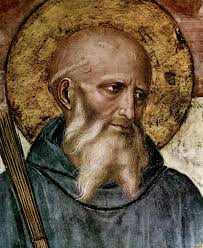
Benedict of Nursia wrote the Rule by which Western monasteries have lived for a millennium and a half. "Pray and work" — ora et labora — is his motto, though those exact words appear nowhere in the Rule. What it does contain is a wisdom of moderation, of common life, of a daily order that makes both prayer and labor possible.
He was born around 480 in Nursia, in Umbria. Sent to Rome to study grammar, he was appalled by the morals of the place and withdrew into the wilderness, living three years as a hermit in a cave near Subiaco. Then the monks of a neighboring monastery prevailed on him to become their abbot. Then they tried to poison him — he was too strict for them.
At Monte Cassino he founded a monastery that became the model. The Rule, written around 540, is a practical document: how much to sleep, how to divide the day between prayer and work, how to receive guests, how to treat the sick. Nothing fanatical about it — moderation as a virtue.
He died around 547. In 1964 Pope Paul VI proclaimed him patron of Europe. His sister Scholastica is venerated as a saint as well.