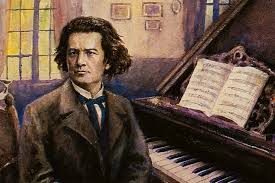
Ludwig van Beethoven is one of the greatest German composers of all time. The future genius was born in Bonn in 1770, into the family of a court musician, and from earliest childhood was taught a range of instruments: organ, violin, harpsichord and flute.
At twelve Ludwig became assistant to the court organist, and the well-known composer Christian Gottlob Neefe took him as a pupil. Among his later teachers were the composers Franz Joseph Haydn, Johann Georg Albrechtsberger and Antonio Salieri.
In 1792 Beethoven moved to Vienna, and within his first few years in the new city had won himself the fame of a virtuoso pianist. It was in Vienna that he wrote his most celebrated works: the Moonlight Sonata, the Pathetique Sonata, and a number of concertos and overtures.
In 1796 his hearing began to trouble him. Inflammation of the middle and inner ear brought on tinnitus, a ringing that hindered him in perceiving and judging not only music but ordinary speech. The condition worsened, and Beethoven began rapidly to lose his hearing.
In 1802, on his doctor's advice, he moved to the small, quiet town of Heiligenstadt in hope of improvement. The cure, alas, did not help, and the composer returned to Vienna. There his friend, the mechanic and inventor Johann Nepomuk Maelzel, made him ear trumpets that helped him make out speech. The collection of Beethoven's ear trumpets is preserved today in his house-museum in Bonn.
Despite the marked deterioration, Beethoven could still hear speech and music until 1812; by 1814, however, he was almost completely deaf. Because of his affliction he all but gave up concert appearances in his last years, and could communicate only by means of his 'conversation books', which record his exchanges with friends on music, politics, society and much else.
To compose, he had to catch the vibration of the instrument. For this Beethoven used a wooden rod, holding one end in his teeth and pressing the other to the instrument. The Ninth Symphony, first heard in 1824, sent its listeners into raptures; the whole hall rose to acclaim the genius — but Beethoven could only see the ovation.
He died in Vienna on 26 March 1827; more than twenty thousand people came to take their leave of him. By his art and his great works Beethoven proved that no deafness can stand in the way of true art.