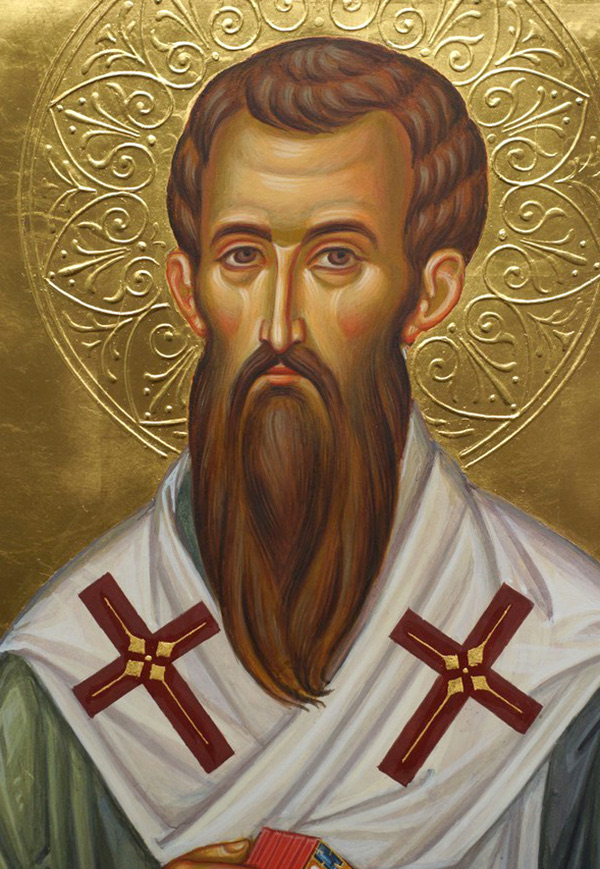
Basil the Great (c. 329, Caesarea in Cappadocia – January 1, 379, in the same city) was a Greek churchman, writer and theologian, the head of the Cappadocian circle and one of the three hierarchs of the Orthodox Church, alongside Gregory the Theologian and John Chrysostom. Born into a devout Christian family, he studied first in Caesarea and in Constantinople, then read philosophy at Athens. On his return (c. 356), after a brief spell of teaching rhetoric, he was baptised and resolved to devote himself to the ascetic life. With a few friends he founded a monastic community near Neocaesarea in Pontus, and to study monasticism at first hand he travelled through Syria, Palestine, Egypt and Mesopotamia. Back home, he compiled with Gregory the Theologian the Philokalia, an anthology of Origen’s writings, and the monastic Rules. In 364 he was ordained priest, and in 370 became bishop of Caesarea in Cappadocia — an office that carried with it the rank of metropolitan of Cappadocia and exarch of Pontus.
He was distinguished by the breadth of his pastoral and charitable activity, but of particular importance was his struggle against Arianism, which enjoyed the support of the emperor Valens and of official circles in Constantinople. His ecclesiastical and theological strategy was to unite against Arianism both the semi-Arians and the adherents of the old Nicene party by means of a reconciling definition of the divine Trinity: “three hypostases in one essence.” He was the first to distinguish the terms “essence” and “hypostasis,” which had previously been used synonymously to denote the unity of God: “hypostasis” he reserved for the threeness of the persons, “essence” for the divine unity. He thereby steered clear of two extremes — the Sabellian merging of the persons and their Arian division.
Basil’s theological and literary work was largely governed by his practical concerns as pastor and church leader. His cosmology shows the influence of the Platonic tradition (Posidonius’s commentary on Plato’s Timaeus); in his trinitarian theology he employs the instruments of Aristotelian logic; and his account of the workings of the Holy Spirit is closely bound up with Plotinus’s conception of the world soul.
The polemical treatise Against Eunomius is directed at the extreme Arians (the Anomoeans) and defends the divinity of the Son and his consubstantiality with the Father. Where Eunomius held that God’s essence could be known through the concept of his unbegottenness — unlike the world he created and the Son who is begotten, God has no beginning or source of his existence — Basil insists that we can know God only through his manifestations, while his essence remains transcendent. The begottenness of the Son means not his emergence out of non-being but his eternal generation by the Father.
Together with Athanasius of Alexandria, Basil the Great inaugurated the theology of the Holy Spirit — before him the theological tradition had confined itself to passing mentions. In the extensive dogmatic epistle On the Holy Spirit he affirms the Spirit’s divinity, though without using the words “consubstantial with the Father” or “God,” so as to avoid a harsh reaction from the Arians.
The monastic Rules, which have come down to us in two recensions, a shorter and a longer, together with Basil’s other ascetic writings, distil the experience he acquired during his life in community, on his journeys among the centres of Eastern monasticism, and in observing the monasteries of Cappadocia. He preferred the communal form of monasticism, since only in the cenobium can the commandment of brotherly love be fulfilled. The Rules exercised a decisive influence on the development and organisation of Eastern monasticism, and in the West were received through Benedict of Nursia, who drew on them in his own Rule.
Basil’s surviving homilies and orations are devoted chiefly to ethical and social questions. Pre-eminent among them are the nine Lenten homilies on the Hexaemeron — the account of the six days of creation in the book of Genesis — in which a strictly creationist understanding of cosmogony is joined to the popular cosmological and scientific notions of antiquity.
A place apart in his legacy belongs to the address To Young Men, on the profit of reading pagan literature: though Greek classical literature is inferior to Scripture, it is nonetheless useful in education, and one should select from it whatever conduces to that end. This view considerably influenced the Church’s attitude toward the cultural inheritance of antiquity.