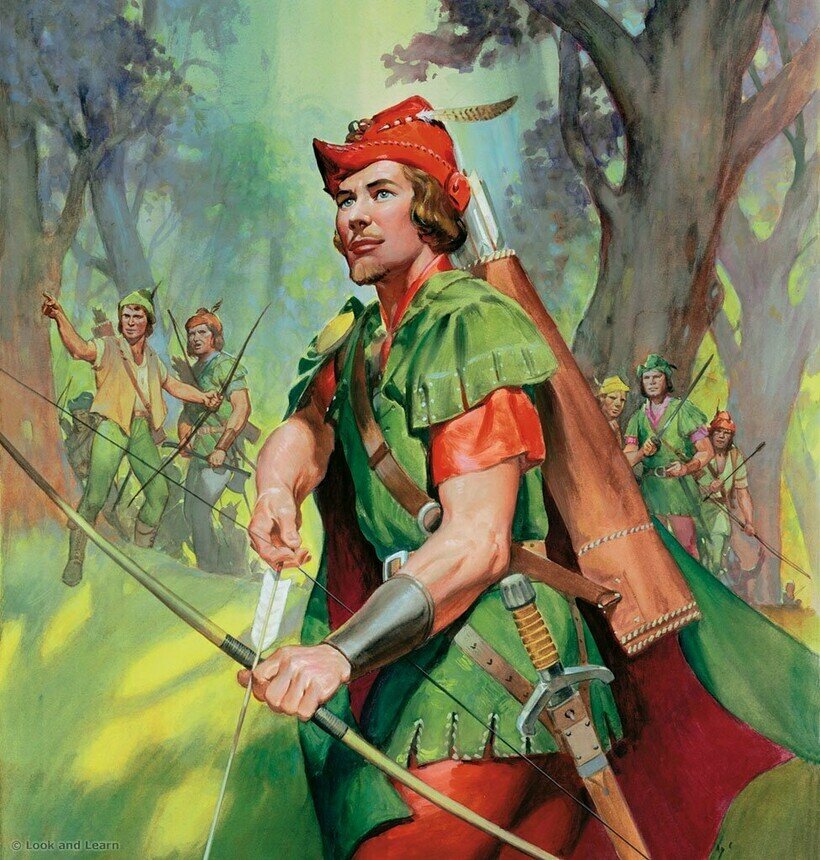
We all first meet Robin Hood in childhood: his image has entered many historical films and works for children. There is a wonderful film with Boris Khmelnitsky, and there are fine poems by Vladimir Vysotsky devoted to the noble outlaw. The question always arises: did such a man really live? Many historians have asked it, and there are various opinions to be confirmed or refuted.
What survive are anonymous works — English folk ballads whose authors are unknown, composed at different periods of history. Most of those who have studied the problem agree that the Robin Hood ballads belong to the fourteenth and fifteenth centuries, though there are earlier and later pieces.
A record of the folk ballads survives from 1495. Its unknown author writes of Robin Hood:
"Robin was a proud outlaw.
He lived and knew no fear,
And loved a merry song."
So the work begins. It presents four famous stories of Robin Hood. In the first, the hero, to rescue a noble knight who has fallen into misfortune, joins with his companion — a giant nicknamed Little John — to lend the knight money, saving him by helping him pay off his debts. It is a model of aid to impoverished gentlefolk brought low by their own honesty and proud temper.
In the second ballad, Robin Hood tricks his chief adversary, the Sheriff of Nottingham, into dining with him — and they dine on venison taken in Sherwood Forest, where no one but the Sheriff of Nottingham had the right to hunt.
The third ballad tells how Robin Hood met King Edward, who had come to Nottingham incognito to investigate the authorities' abuses against the common people. In the end Robin Hood even entered his service.
The fourth ballad, a later one, recounts Robin Hood's death, brought about by the prioress of Kirklees Abbey — a woman who treacherously bled him to death.
These are the four core stories, which later gathered new details and new characters. The image received its final stroke of fortune in 1819, when Walter Scott made Robin Hood a character in his novel "Ivanhoe"; after that the noble English outlaw was famous the world over. But Scott was not alone: other English writers had turned again and again to this figure, known in England since the Middle Ages.
It is not hard to see why Robin Hood is so popular and so appealing. The greater part of the population — poor peasants, ordinary townsfolk, even knights — lived in constant hardship, and among these classes the dream of a noble, strong, handsome man who would come to their rescue never faded. Robin Hood has had many successors: Vladimir Dubrovsky, the hero of Alexander Pushkin's novella, is just such a man.
Robin Hood possessed qualities that made him irresistible to the medieval imagination. First, he helps everyone — not only common folk but noble knights in distress. He belongs to no single estate, and so the legend was loved by all; had he helped only commoners, the nobility would have cared far less for him. Second, the legendary Robin Hood honors what medieval people held dear. He treats religion with respect: the ballads do not show him at church, but he never commits a crime against a priest, and in the later tales he gains a companion — the good-natured, portly Friar Tuck, who shares his exploits and helps the people. He is loyal, too, to his monarch, taking no action against him; on the contrary, he helps him, and the king at times takes him into his service.
Medieval authors mention Robin Hood. In 1377 William Langland, in his poem "Piers Plowman," cites "rhymes of Robin Hood." Geoffrey Chaucer, the celebrated English writer of the late Middle Ages and author of "The Canterbury Tales," refers to the legendary outlaw twice: in one work he describes woods and hazel thickets where once "Robin Hood walked," while in "The Tale of Gamelyn," though Robin Hood is not named, there appears a noble outlaw who acts exactly as he does.
Did Robin Hood exist? Did such a man truly live? In England one can find men who bore the same or a similar name, or whose lives contained similar episodes. They were real, but none of them matches, point for point, the Robin Hood of the legends; other countries, too, had men of similar fate. Most likely there was no single such man. He is a creation of the popular muse, a legend passed from mouth to mouth, the hero people longed to see as their protector — a figure who exalts the common man fighting for justice, and the attainment of justice has always been the dream of millions. That is why the image of Robin Hood is so compelling, and why the unknown author of the ballads dated 1495 closes with these words: "Lord, have mercy on his soul, for he was a noble outlaw and always helped the people."