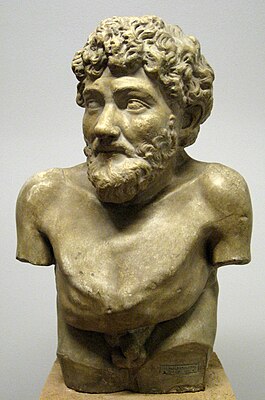
Aesop was born around 620 BC in Mesembria — if, that is, he was born at all: whether he was a historical figure is impossible to say. He is first mentioned by Herodotus, who reports that Aesop was the slave of a certain Iadmon on the island of Samos, was later set free, lived in the time of the Egyptian king Amasis (570–526 BC), and was killed by the Delphians — for his death Delphi paid a ransom to Iadmon's descendants. His death is conjecturally dated to 564 BC.
More than a century later, Heraclides Ponticus writes that Aesop came from Thrace, was a contemporary of Pherecydes, and that his first master was named Xanthus. But these details are extracted from Herodotus's earlier account by unreliable inference — Thrace as Aesop's homeland, for instance, was suggested by the fact that Herodotus mentions Aesop in connection with the Thracian courtesan Rhodopis, likewise a slave of Iadmon.
Aristophanes, in The Wasps, already supplies details of Aesop's death: the wandering motif of the planted cup that furnished the pretext for his accusation, and the fable of the eagle and the beetle that he told before dying. A century on, what Aristophanes's characters assert is being repeated as historical fact.
The comic poet Plato, at the end of the fifth century, already speaks of the posthumous transmigrations of Aesop's soul; the comic poet Alexis, at the end of the fourth, wrote a comedy called Aesop in which the hero meets Solon — weaving the legend of Aesop into the cycle of tales about the Seven Sages and King Croesus.
His contemporary Lysippus knew this version too, portraying Aesop at the head of the Seven Sages. Slavery under Xanthus, the link with the Seven Sages, death by the treachery of the Delphic priests — all these motifs became links in the later Aesopic legend, whose core had taken shape by the end of the fourth century BC.
The chief monument of that tradition is an anonymous late-antique novel in Greek known as the Life of Aesop. It survives in several redactions: the oldest papyrus fragments date from the second century AD, while from the eleventh century onward a Byzantine redaction of the Life circulated in Europe.
In the Life, much is made of Aesop's ugliness — of which the earlier authors say nothing; his homeland becomes Phrygia rather than Thrace (a stereotypical land of slaves), and Aesop figures as a sage and jester who makes fools of kings and of his own master, a dim-witted philosopher. Remarkably, the fables themselves play almost no part in this story: the anecdotes and jokes Aesop tells in the Life do not belong to the corpus of "Aesop's fables" that antiquity handed down, and as a genre they stand rather far from it. It was this figure — the ugly, wise, cunning "Phrygian slave" — that passed ready-made into the modern European tradition.
Antiquity never doubted that Aesop was real. Luther, in the sixteenth century, was the first to question it; eighteenth-century philology gave the doubt a scholarly footing (Richard Bentley), and the nineteenth century carried it to the limit — Otto Crusius, and Rutherford after him, pronounced Aesop mythical with all the resolve of their age's hypercriticism. In the twentieth century, individual scholars have again allowed for the possibility of a historical prototype of Aesop.