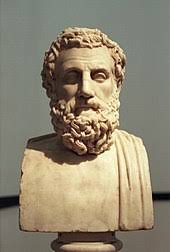
Aeschylus was born at Eleusis in 525 BC and spent most of his life in Athens.
He carried tragedy a step further by adding a second actor, which made more complex action possible on stage; the singing of the chorus, moved into the background, now supplied the general atmosphere of the play.
He began to stage his dramas not singly but in trilogies. At first the three plays of a trilogy had no connection with one another, but in time they came to be written on the plot of a single myth, carried from beginning to end — which allowed a fuller working-out and a deeper coherence of the story.
He drew his themes freely from the poems of Homer. From the scant accounts of his life we know that he fought in the Greco-Persian wars in person — at Marathon, at Salamis and at Plataea.
The direct impress of the shattering events of those years deepened the drama of his plays.
The titles of 82 tragedies by Aeschylus are known, but only seven have come down to us: The Persians, The Suppliants, Seven Against Thebes, Prometheus Bound, Agamemnon, The Libation Bearers and The Eumenides. Only the last three form a complete trilogy. The Persians and The Suppliants belong to his early manner: very simple in construction, with the action barely developed and the principal figures showing little individuality — they are generalized images rather than persons (kings, unhappy exiles). Though there are two actors, they seldom appear on stage together, and the chorus still holds first place.
The Persians and The Suppliants are cantatas rather than tragedies in the modern sense. In the later plays, however, the growth of Aeschylus's dramatic form is unmistakable.
His younger contemporary and countryman Sophocles had by then begun to use a third actor, and Aeschylus sometimes borrowed the device.
In Seven Against Thebes Aeschylus gives us no longer a general type but a vividly individual portrait of his hero, Eteocles; here he trims the choral parts and enlarges the actors' dialogue at their expense. The hero of Prometheus Bound is likewise drawn in living colors. Yet in both plays there is almost no action beyond the central figures. Action in its full vigor arrives only in the late tragedies — Agamemnon, The Libation Bearers and The Eumenides, united in the Oresteia trilogy. These are the most accomplished of the works of Aeschylus known to us: the role of the chorus shrinks further still, the heroes take on ever more individual features, and the action grows tense and gripping.
Aeschylus's plays are steeped in solemnity and grandeur. True to the spirit and events of the age his life was bound up with, he depicted genuinely heroic passions, often driving his characters to defiance of the gods, to challenges hurled at the moral and metaphysical foundations of the world order. In the finales of his tragedies the heroes come to see the futility of their assault on the holy of holies and submit — freely or under compulsion — to the divine measure. Such is the governing idea of his work.
He died in 456 BC at Gela, in Italy.