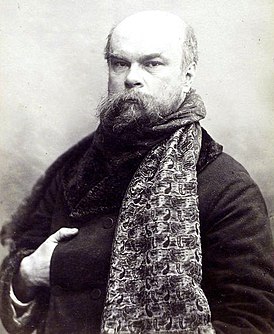
Paul-Marie Verlaine was born in Metz on 30 March 1844, the son of Nicolas-Auguste Verlaine, a captain of engineers, and Élisa-Julie-Josèphe-Stéphanie Dehée. Garrison life kept the family moving through his early childhood — Metz, Montpellier, Nîmes, Sète, and Metz again — until the captain retired in 1851 and settled in the Paris suburb of Batignolles. In 1853 the boy entered the Landry boarding school at 32 rue Chaptal, and in 1855 the lowest form of the Lycée Bonaparte, the future Condorcet. By 1858 he was writing verse and reading Hugo, Banville, Gautier, Baudelaire, Leconte de Lisle, and Glatigny; on 12 December he sent Victor Hugo a poem entitled "Death." From 1860 dates his friendship with Edmond Lepelletier, his future executor and biographer.
In 1862 the family's finances suffered from unlucky investments. Verlaine took his baccalaureate in letters, with distinction in Latin, enrolled at the law school, and worked at arithmetic in hopes of sitting an examination for the Ministry of Finance. He also began drinking and frequenting brothels, and devoured Büchner's Force and Matter. In 1863 he met the poet and critic Louis-Xavier de Ricard; in the republican salon of the Marquise de Ricard at 10 boulevard des Batignolles his companions were Théodore de Banville, Auguste Villiers de l'Isle-Adam, François Coppée, Catulle Mendès, Sully Prudhomme, and José-Maria de Heredia. That August came his first publication, the sonnet "Monsieur Prudhomme," in Ricard's Revue du progrès.
From January to March 1864 he worked in an insurance company, then at the town hall of the ninth arrondissement, abandoning his law studies; in the autumn and winter he frequented Catulle Mendès's circle — Prudhomme, Villiers de l'Isle-Adam, Léon Dierx, Heredia, Albert Glatigny. In 1865 he was a dispatch clerk at the Paris Hôtel de Ville; in November and December he published an essay on Baudelaire and several poems in Ricard's new journal L'Art, met the publisher Alphonse Lemerre — in whose bookshop at 47 passage Choiseul the future Parnassians gathered — and attended Théodore de Banville's evenings in his apartment in the rue de Condé. On 30 December his father died.
In January 1866 Verlaine and his mother moved to 26 rue Lécluse. March brought the first issue of the almanac Le Parnasse contemporain, published by Lemerre; on 28 April eight of Verlaine's poems appeared in its ninth fascicle — where they were read by a twelve-year-old named Rimbaud. In November his collection Poèmes saturniens appeared under Lemerre's imprint. On 16 February 1867 died Élisa Dujardin, née Moncomble, his cousin and the friend of his childhood; orphaned young, she had been taken in and raised by Verlaine's parents, and after her marriage had helped him financially with the publication of his first book of verse. The loss struck him hard, and he sought oblivion in absinthe. On 25 July he began contributing to Le Hanneton, the satirical journal of the publicist and future Communard Eugène Vermersch. On 12 August, in Brussels, Victor Hugo received him warmly. Charles Baudelaire died in Paris on 31 August, and on 2 September Verlaine attended his funeral at the Montparnasse cemetery. In December a plaquette, Les Amies, scenes of sapphic love, appeared in Brussels under the pseudonym Pablo de Herlagnez, published by Auguste Poulet-Malassis.
In 1868, along with the Parnassians, Verlaine was a fixture of Nina de Villard's salon at 17 rue Chaptal, whose guests included Berlioz, Wagner, and Manet. On 6 May a court at Lille ordered the edition of Les Amies confiscated and destroyed and fined the publisher five hundred francs. August he spent on holiday with relatives at Paliseul in Belgium. In February 1869 came Fêtes galantes, again from Lemerre. On 22 March he and his mother traveled to Paliseul for an aunt's funeral; he drank hard, family and local authorities called him to order, and Madame Verlaine resolved to marry her son to one of the Paliseul cousins. In June, Charles de Sivry, a musician of Nina's salon, introduced him to his own cousin, Mathilde Mauté de Fleurville. In July Madame Verlaine carried her son off to relatives at Fampoux in the Ardennes and returned to Paris; Verlaine drank. On 18–20 July, in a letter to Sivry, he asked for Mathilde's hand — partly to escape the Paliseul cousin. The answer was guardedly encouraging (the father of the fifteen-year-old Mathilde took a great deal of persuading); Verlaine gave up drink and began his courtship. That autumn and winter he received friends on Tuesdays — Coppée, Charles and Antoine Cros, Lepelletier, Ricard, Sivry, Valade, Mathilde.
In June 1870 La Bonne Chanson, dedicated to Mathilde, was printed by Lemerre (it would not go on sale until January 1872). On 11 August Paul and Mathilde were married at Notre-Dame de Clignancourt in Montmartre, and the newlyweds settled at 2 rue du Cardinal-Lemoine. The Franco-Prussian War ran from July to September; on 22 August, in a letter to his teacher Georges Izambard, Rimbaud declared his admiration for Fêtes galantes and La Bonne Chanson. On 2 September came the catastrophe of Sedan; on the 4th the Republic was proclaimed and general mobilization declared, and Verlaine volunteered for the National Guard. In January 1871 Prussian troops besieged and bombarded Paris; Paul and Mathilde moved to the boulevard Saint-Germain, where they kept a salon whose newer guests included the poet Eugène Pelletan, the painter Félix Régamey, and the composer Ernest Cabaner. Through the Commune of March–May, despite Thiers's order forbidding officials to report for duty, Verlaine kept on working at the Hôtel de Ville, in the press bureau. The couple returned to the rue du Cardinal-Lemoine, and after the fall of the Commune — fearing denunciations — took refuge with Verlaine's relatives at Fampoux and Lécluse. In August they were back in Paris, lodging in the Mauté house at 14 rue Nicolet.
In late August and early September came letters from Arthur Rimbaud — poems, and a plea for support. Verlaine invited him to Paris and paid his fare. On 10 September Rimbaud arrived and was installed with the Mautés, who before long turned him out for rudeness and uncleanliness; he lodged in turn with Banville, Charles Cros, the composer Cabaner, the painter Forain. Verlaine and Rimbaud took part in the gatherings of the literary circles the Vilains Bonshommes and the Zutistes, drank, and their friendship grew into what they themselves called the "fierce passion" of two poets. At the end of October came Verlaine's first quarrel with Mathilde over Rimbaud, who was bent on wrenching Verlaine the Poet out of the stifling petit-bourgeois atmosphere of the Mauté household. On 30 October Georges Verlaine, son of Paul and Mathilde, was born. In late December, at a dinner of the Vilains Bonshommes, Rimbaud made a scene and lightly wounded the photographer Carjat with a sword-cane; expelled from the circle, he was set up by Verlaine in a room at 14 rue Campagne-Première.
In January 1872 Henri Fantin-Latour painted The Corner of the Table, placing Verlaine and Rimbaud among the assembled Parnassians. On 13 January, in a quarrel, Verlaine struck his wife and threatened to kill their son, then hid for several days at his mother's. In mid-January Mathilde took Georges to relatives in Périgueux, and Verlaine moved in with Rimbaud in the rue Campagne-Première. On 20 January he wrote to Mathilde begging her forgiveness. Early in February the Mauté de Fleurville family began divorce proceedings. In March Verlaine promised Mathilde to break with Rimbaud, who at Verlaine's request left for Charleville; the proceedings were suspended; Verlaine returned to his wife but went on corresponding with Rimbaud in secret, and took a job at an insurance company. In April he asked Rimbaud to come back. Early in May, drunk, he snatched up little Georges and carried him off to his mother's; the next morning Mathilde asked her attorney to reopen the divorce suit. On 18 May Rimbaud returned to Paris. Through May and June Verlaine several times threatened to kill Mathilde; he and Rimbaud, by way of amusement, fought with knives, and Verlaine passed off his wounds as fencing lessons.
On 7 July, going out to fetch a doctor for the ailing Mathilde, Verlaine ran into Rimbaud, and they resolved to leave Paris at once — for Arras, where the gendarmerie sent them back; changing trains in Paris, they made for Brussels. In France the persecution of those who had collaborated with the Commune, or had simply gone on working in its offices, was still savage; many of Verlaine's friends and acquaintances were in prison, he himself was under suspicion with the new authorities and in real danger, kept under constant watch — and so, fleeing persecution, he decided to escape abroad. Through July the two vagabonded across Belgium. On 21 July Mathilde, escorted by her mother, came to Brussels to bring Paul home; they very nearly succeeded, but at the border station Verlaine abandoned them and returned to Brussels with Rimbaud, who had been riding the same train in secret. On 7–9 September the two crossed to London, settling at 34–35 Howland Street. In December Rimbaud's mother, learning what the Mautés were accusing him and Verlaine of, ordered her son back to Charleville, and he obeyed. Verlaine fell ill and summoned his mother and Rimbaud.
Verlaine's mother reached London early in January 1873; in mid-January Rimbaud followed, his fare paid by her; early in February she returned to Paris. In late March Verlaine wished to go back to Paris and be reconciled with Mathilde. On 4 April he left for Belgium — first to his mother's acquaintance the abbé Delogne at Namur, from where he wrote to Mathilde asking for a meeting and a reconciliation (she asked him to stop pestering her with letters), then to relatives at Jehonville, where he finished Romances sans paroles and studied English. On 9–10 April Rimbaud returned to Charleville and began A Season in Hell. On 24–25 May the two went back to London and took two small rooms on the top floor of No. 8 Great College Street (now 8 Royal College Street). In June Verlaine again wanted to return to Mathilde; the quarrels with Rimbaud were constant. On 4 July, after one more of them, Verlaine left for Brussels, abandoning Rimbaud without money; he put up at the Hôtel Liégeois and wrote from Brussels to his wife, his mother, and Rimbaud, threatening suicide. His mother arrived on 5 July; Rimbaud on the 8th, insisting on returning to Paris over Verlaine's objections. On the morning of 10 July Verlaine bought a revolver and got drunk; at about three in the afternoon, in the hotel, he fired at Rimbaud and wounded him in the wrist. Verlaine and his mother took Rimbaud to the hospital; he still insisted on leaving; they walked him to the station, Verlaine threatening along the way to shoot himself; the frightened Rimbaud ran to a policeman for help, and Verlaine was arrested — even though Rimbaud withdrew every one of his accusations. On 11 July Verlaine was placed in the Petits-Carmes remand prison. On 20 July Rimbaud returned to Charleville, to the farm at Roche, where he would finish A Season in Hell. On 8 August the Brussels court sentenced Verlaine to two years in prison; on 27 August he was transferred to solitary confinement at Mons.
In March 1874, through the efforts of Edmond Lepelletier, Romances sans paroles appeared at Sens, from the press of Maurice L'Hermitte. The division of property with Mathilde followed, and Verlaine was ordered to pay support; in prison he underwent a religious crisis and made his confession. He was released on 16 January 1875. In February came his last meeting with Rimbaud, at Stuttgart; Verlaine's new piety irritated Rimbaud, who asked him to pass the manuscript of the Illuminations to the poet Germain Nouveau — his companion on a journey to England in the spring of 1874 — for possible publication. In March Verlaine went to England and took a post as a primary schoolmaster at Stickney; in London he met Germain Nouveau and handed over the Illuminations (finding no publisher, Nouveau would return them to Verlaine in the autumn of 1877). In October Verlaine sent poems to Paris for the third Parnasse contemporain, and his former colleagues, led by Anatole France, denied him the honor. On 12 December he wrote his last letter to Rimbaud. Through 1876 and 1877 he taught Latin, French, and drawing at Stickney, Boston, and Bournemouth. In October 1877 he returned to France and took a teaching post at the Catholic college in Rethel, where he met Lucien Létinois and in effect adopted him.
In the spring and summer of 1878 he twice saw his son and tried, without success, to renew relations with Mathilde. At the end of the summer of 1879 he got drunk in the company of his pupils; his criminal record, moreover, came to light; he left Rethel and went to London with Létinois. In March 1880 he bought a farm at Juniville in the name of Létinois's parents and settled there beside Lucien's family while the young man farmed. In December appeared the collection Sagesse, from the publisher Victor Palmé. In 1882, the elder Létinois having managed its affairs badly, the Juniville farm was sold for debts; in July Verlaine returned to Paris to rebuild his literary connections and tried in vain to obtain a post at the town hall, living in a hotel near the Bois de Boulogne at 5 rue Parchamp. On 7 April 1883 Lucien Létinois died suddenly of typhoid. Verlaine took the death hard; he would later mourn the untimely loss of his adopted son in a sequence of twenty-five piercing poems, gathered in the collection Amour. Between July and September his mother bought the farm at Coulommes from Lucien's parents and moved there with her son. Verlaine was drinking again.
In March 1884 Vanier published his essays on Arthur Rimbaud, Tristan Corbière, and Stéphane Mallarmé under the title Les Poètes maudits — The Accursed Poets; in November came the collection Jadis et naguère, from Léon Vanier. In February 1885, after a quarrel, his mother took refuge with neighbors; Verlaine burst in, raged, and threatened to kill himself if she did not come home; Madame Verlaine took her son to court. On 8 March he sold the house at Coulommes; on 24 March the court at Vouziers sentenced him to a month in prison and a fine of five hundred francs. In May the divorce from Mathilde was made official. In July mother and son moved to Paris (6 impasse Saint-François — 5 rue Moreau). In August arthritis left him unable to walk. In November he was at work on a series of literary portraits, Men of Our Day. There were forewarnings of fame: the first song set to his verse (Ernest Amédée Chausson's setting of "The white moon," from La Bonne Chanson), and a literary caricature of him in Henri Beauclair and Gabriel Vicaire's parody volume Les Déliquescences, decadent verses of Adoré Floupette.
In January 1886 Gustave Kahn and Jean Moréas founded the paper Le Symboliste. On 21 January Verlaine's mother died. Mathilde obtained a settlement under which she paid Paul's debts and took Madame Verlaine's estate of twenty thousand francs against unpaid alimony, leaving Verlaine without means. In February an aunt died, leaving him 2,400 francs. In February and March he took up with the prostitute Marie Gambier, who left him once the inheritance ran out. That spring he met the artist and song-writer Frédéric-Auguste Cazals, whose friendship would last until Verlaine's death. On 10 April appeared the first number of Le Décadent, the paper of Anatole Baju and Maurice du Plessys. On 18 September, in the literary supplement of Le Figaro, Moréas published the manifesto of Symbolism, naming Verlaine — together with Baudelaire and Mallarmé — a forerunner of the new poetic school. In October and November Léon Vanier brought out Verlaine's prose, Memoirs of a Widower and Louise Leclercq. On 30 October Mathilde married Bienvenu-Auguste Delporte, and with her change of name the bar was lifted on the publication of Rimbaud's Illuminations, which Verlaine had improvidently left, in the autumn of 1877, in the keeping of Charles de Sivry, Mathilde's cousin. From November 1886 to March 1887 Verlaine lay in the hospital.
Through 1887 he wandered from hospital to hospital. In September he met the prostitute Philomène Boudin, who became his mistress. In January 1888 Jules Lemaître published in the Revue bleue an article, "Paul Verlaine, the Symbolists and the Decadents." In March came the collection Amour, from Vanier. Verlaine settled in a hotel at 14 rue Royer-Collard, then moved to one at 216 rue Saint-Jacques, where he held literary Wednesdays. In August appeared the second edition of Les Poètes maudits, enlarged with essays on Marceline Desbordes-Valmore, Auguste Villiers de l'Isle-Adam, and "Pauvre Lélian" — an anagram of Paul Verlaine. From November 1888 to February 1889 he was in the hospital. Charles Morice published his book Paul Verlaine with Vanier.
In February 1889 Verlaine settled at 4 rue de Vaugirard and resumed his Wednesdays. In June came Parallèlement, from Vanier. July and August found him in the hospital; in August and September, at his friends' expense, he took a cure at Aix-les-Bains; from September 1889 to February 1890 he was in the hospital again. In February 1890 he moved in with Philomène in the rue Saint-Jacques. In July the Ministry of Public Instruction granted him an allowance of two hundred francs. In December appeared Dédicaces, from Vanier, and, clandestinely in Brussels, the collection of erotic verse Femmes, from the publisher Kistemaeckers.
January and February of 1891 were spent in the hospital. In May, at a benefit for Verlaine and Paul Gauguin, the Théâtre d'Art staged his play Les Uns et les autres. He met Eugénie Krantz, a former dancer and a friend of Philomène's; she became his mistress and soon ruined him. In May and June came the collection Bonheur and the play Les Uns et les autres, from Vanier, and a Selected Poems from the house of Fasquelle in the Bibliothèque Charpentier series. From October 1891 to January 1892 he was in the hospital. In November appeared his autobiographical prose Mes hôpitaux — My Hospitals — from Vanier. On 10 November Arthur Rimbaud died of a sarcoma at Marseille. In December came Chansons pour elle, from Vanier.
Out of the hospital in January and February 1892, Verlaine lived for a time with Eugénie; as soon as the money ran out, she left him. In April the collection Liturgies intimes appeared in the Bibliothèque du Saint-Graal series. From August to October he was in the hospital. From 2 to 14 November, at the invitation of Dutch men of letters, he traveled to Holland to lecture on literature. December 1892 to January 1893: the hospital again. In January 1893 he and Eugénie settled at 9 rue des Fossés-Saint-Jacques. In February and March, at the invitation of Belgian writers, he lectured in Belgium. In May and June came Élégies, Odes in Her Honor, and the autobiographical Mes prisons — My Prisons — all from Vanier. From June to November he was in the hospital: erysipelas of the left leg, regular punctures; Philomène visited him there. In August he put forward his candidacy for the French Academy, for the seat of the late Hippolyte Taine; in October the seat went elsewhere. In November he moved in with Philomène; in November and December, at the invitation of English men of letters, he lectured in London, Oxford, and Manchester. In December his lectures appeared as Fifteen Days in Holland, from the publishers Blocq and Vanier, and he moved in with Eugénie at 187 rue Saint-Jacques.
In April 1894 he moved back to Philomène. In May came the collection Dans les limbes, from Vanier. From May to July he was in the hospital, trying meanwhile to restore relations with Eugénie. In August, on the death of Charles Leconte de Lisle, he was elected Prince of Poets; friends led by Maurice Barrès and Robert de Montesquiou-Fézensac settled on him a monthly pension of 150 francs, and the Ministry of Public Instruction paid him an allowance of 500 francs (two more such grants would follow, in February and September 1895). In October his play Madame Aubin was staged at the café Procope; he left Eugénie and moved in with Philomène. In December the collection Épigrammes appeared from the press of the journal La Plume, in its Literary and Artistic Library series. December 1894 to January 1895: the hospital.
In February 1895 he moved back to Eugénie. In May his Confessions appeared from the publishing house Fin de siècle. In September he and Eugénie moved to 39 rue Descartes, and his condition worsened sharply. In October came the complete works of Arthur Rimbaud, with a preface by Verlaine. On 7 January 1896 Verlaine made his confession. That night he fell out of bed; Eugénie could not lift him, and he spent the whole night on the cold floor. On 8 January he died of pneumonia. On the 10th, after the funeral service at Saint-Étienne-du-Mont, he was buried with solemn honors in the Batignolles cemetery.
In February 1896 the collection Chair appeared in the Literary and Artistic Library series; in December, Invectives, from Vanier. In 1899 Vanier issued the complete works of Verlaine in five volumes. In 1904 the collection of erotic verse Hombres ("Men") was published clandestinely by Albert Messein, Vanier's successor. In 1907 Messein brought out a book of Verlaine's notes, A Frenchman's Journey through France. On 28 May 1911 a monument to Verlaine by Auguste de Niederhausern-Rodo was unveiled in the Luxembourg Gardens. In 1913 Henri Floury published the Biblio-sonnets; in 1926 the publisher Bodinier issued the first volume of Verlaine's unpublished works, and in 1929 Albert Messein the second and third.