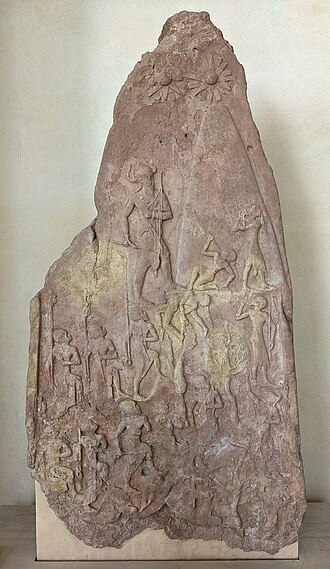
The Stele of Naram-Sin is less the name of a single object than of a whole epoch in the history of art. This Akkadian monument was carved in the twenty-third century BC under King Naram-Sin, grandson of the celebrated Sargon the Great. It was an age of upheaval and revolutionary ideas, and the stele stands as one of its most vivid expressions.
The chief work associated with Naram-Sin is, of course, the stele itself — a victory monument recounting the story of the king's conquests. What makes it remarkable is that its composition was entirely new, revolutionary for its time: in place of the traditional horizontal registers, the artists set the figures in a diagonal movement upward, toward the summit of a mountain. It is one of the earliest works of art to employ elements of perspective and landscape, and this is what makes it genuinely singular and absorbing.
The key ideas embodied in the stele, and its contribution to culture, can hardly be overstated. Naram-Sin's artists were among the first to bring perspective and landscape into their work, opening new possibilities for the development of art. Beyond that, the stele is one of the earliest examples of art pressed into service as propaganda, as a weapon in an ideological struggle. This was a new and striking direction — art that could express not only feeling and thought but could also shape public opinion.
Yet, like any artist, Naram-Sin faced his share of difficulties and paradoxes. The stele was made in a time of great change and of war, and not everyone was pleased with it. The king himself was a rather contradictory figure, and his legacy became the subject of long dispute. For all that, his stele remains one of the most interesting and important works of art of the ancient world.
Today the Stele of Naram-Sin matters not only as a historical monument but as a demonstration of how art can act upon society and culture. It continues to inspire artists and historians, and its handling of perspective and landscape has lost none of its interest. It also testifies that art can be more than a vehicle for emotion and thought — it can be an instrument of influence, of ideological contest. All of this makes Naram-Sin a genuinely compelling figure in the history of art, and his stele essential study for anyone drawn to the history and culture of the ancient world.