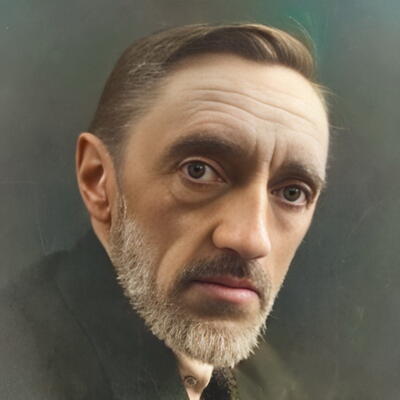
On 21 September (3 October, New Style) 1873, in Moscow, a fifth child, Ivan, was born to the building contractor Sergei Ivanovich Shmelev and his wife Evlampiya Gavrilovna. His earliest memories were of the solid, settled order of a large merchant household. His father owned public bathhouses and ran an artel of carpenters three hundred strong: it was Shmelev’s artel that raised Moscow’s ice-slides at Shrovetide, built the scaffolding for the Cathedral of Christ the Saviour, and put up the stands for the unveiling of the Pushkin monument. The family’s way of life had a peculiar Old Believer democratism about it: masters and workmen fasted together, together kept the rites and moral covenants of the old days, went on pilgrimages, and lived not merely side by side but as one. At six, Ivan made a pilgrimage with his minder Mikhail Gorkin to the Trinity-Sergius Lavra and received a blessing from the elder Varnava, a renowned spiritual teacher of the day — a journey later described in the novel The Pilgrimage. Ivan loved and revered his minder, and many years later he wrote: “Two people formed my soul: my father and the carpenter Gorkin.”
When Ivan was seven, his father fell from an unbroken horse and was dragged along the road; Sergei Ivanovich died on 7 October 1880. Vanya, who had adored him, watched the funeral procession from the window. With the head of the family gone, the Shmelevs lived hard — and there were six children now. Evlampiya Gavrilovna had a head for business: the bathhouses turned a profit, and she let out part of the house to lodgers. By nature she was stern and despotic; she beat her sons with the birch regularly, and not for any offense — the schooling at home began and ended with the rod.
Like children of merchant and noble families alike, Ivan learned his letters at home, and his mother was his first teacher; with her he “went through” Krylov, Tolstoy, Pushkin, Gogol, Turgenev. At the Sixth Moscow Gymnasium, which he entered in 1884, his reading widened — Tolstoy, Uspensky, Leskov, Korolenko, and Melnikov-Pechersky became favourites. But Pushkin always remained Shmelev’s “creed”: one need only read his essays “The Faithful Ideal,” “The Secret of Pushkin,” and “A Cherished Meeting.” His new teacher of literature was Fyodor Tsvetaev — an uncle, as it happens, of Marina Tsvetaeva — from whom the gifted pupil earned top marks with two and three pluses for his compositions; and he began writing novels and stories in imitation of Zagoskin, Melnikov-Pechersky, Gleb Uspensky, and Leo Tolstoy.
In the summer of 1893 Olga Alexandrovna Okhterlony, a student at the Patriotic Institute, came to stay with relatives who lodged with the Shmelevs. She was sixteen. Olga came of an impoverished Scottish noble line related to the Stuart dynasty; her great-grandfather had come to Russia under Catherine II. Intelligent, well-read, and devout, she wanted to become a village schoolteacher. Ivan was taken with her from the very first days and called on her constantly. His mother was dead set against the friendship and hindered it however she could.
Shmelev finished the gymnasium in 1894 and entered the law faculty of Moscow University. Evlampiya Gavrilovna found her son a rich bride, a merchant’s daughter, but Ivan and Olga out-stubborned her. A lavish wedding was celebrated at the family estate on the Klyazma, and the young couple set off on their honeymoon — first to the Trinity-Sergius Lavra, to the elder Varnava, and then to Valaam. Varnava sent the bridegroom off with the words: “You will be exalted by your talent.” Two years later Shmelev’s Valaam diary appeared under the title On the Cliffs of Valaam.
On the night of 6–7 January 1897 a son, Sergei, was born to the Shmelevs; fatherhood would become one of the great themes of Shmelev’s prose. For the moment, though, there was a family to feed, and On the Cliffs of Valaam sold poorly. In the end Shmelev put literature aside for eight years. He took his degree in 1898, served his term in the army, and joined the Moscow bar — but the bar proved “not his,” a kind of sophistry. In 1901 the family moved to Vladimir, where he worked as a tax inspector, a post that meant constant travel through the provinces — and an accumulating store of worldly and professional experience. As Ivan Ilyin, one of the finest students of Shmelev’s work, put it: “When he writes, he listens to the grass of Russian life growing, to the groaning and aching of the Russian soul…”
Working hard and gaining faith in his own powers, Shmelev left the service in 1907 to give himself wholly to literature. His pre-revolutionary work appeared in the journals Russkoye Bogatstvo and Russkaya Mysl and in the anthologies of Znanie, the publishing house organized by Maxim Gorky. The novella The Man from the Restaurant (1911) made his name, and in time an eight-volume edition of his works was published. By 1917 readers had come to love him and critics praised him, comparing him to Dostoevsky.
Shmelev greeted the February Revolution of 1917 with enthusiasm; after the events of October his attitude to the new power turned deeply critical. In the autumn of 1918 he left for Alushta, where he had a small property. There he lived through all the horrors of the Civil War — which ended, for him, with the arrest and execution of his only son, a White officer, one of the victims of the reprisals against the defeated after the fall of Wrangel’s government. Shmelev searched for his son’s grave in vain. The events of those years went into the autobiographical novella The Sun of the Dead (1923). The Shmelevs’ little adobe house in Alushta still stands; it is now a museum of the writer.
In January 1922, having got out of Red Russia for medical treatment abroad, he wrote: “We are in Berlin! For what, who knows. I fled my grief. In vain… Olya and I are broken in soul and drift without aim…” From Berlin, at Bunin’s invitation, they moved to Paris. Shmelev did not yet know that he would never see his homeland again. After all he had endured he grew thin and aged past recognition: the upright, ever lively and vigorous man had become a bent, grey-haired old one. All his life he had suffered from a stomach ulcer, and now it worsened.
Without his wife, who shielded him and made for him “quiet and order,” “that which no longer exists in Russia,” there would have been no Pilgrimage, no Year of the Lord, none of Shmelev’s other works. Olga Alexandrovna died suddenly of a heart attack in 1936. To draw the writer out of his dark thoughts, friends arranged a journey for him to Latvia and Estonia. He visited the Pskov-Caves Monastery and stood at the Soviet border; reaching through the wire of the fence, he picked a few flowers.
On 24 June 1950, shortly before his end, Shmelev came to the convent of the Protection of the Most Holy Mother of God, 140 kilometres from Paris. That same day a heart attack cut short his life. Mother Feodosia, the nun present at his passing, wrote: “…the man came to die at the feet of the Queen of Heaven, under Her Protection.”
In April 2000 Shmelev’s great-nephew Yves Gentilhomme-Kutyrin gave the writer’s archive to the Russian Culture Foundation, and in May 2001, with the blessing of His Holiness the Patriarch, the remains of Shmelev and his wife were carried home to Russia, to the necropolis of the Donskoy Monastery in Moscow, where the Shmelev family burial plot has been preserved.