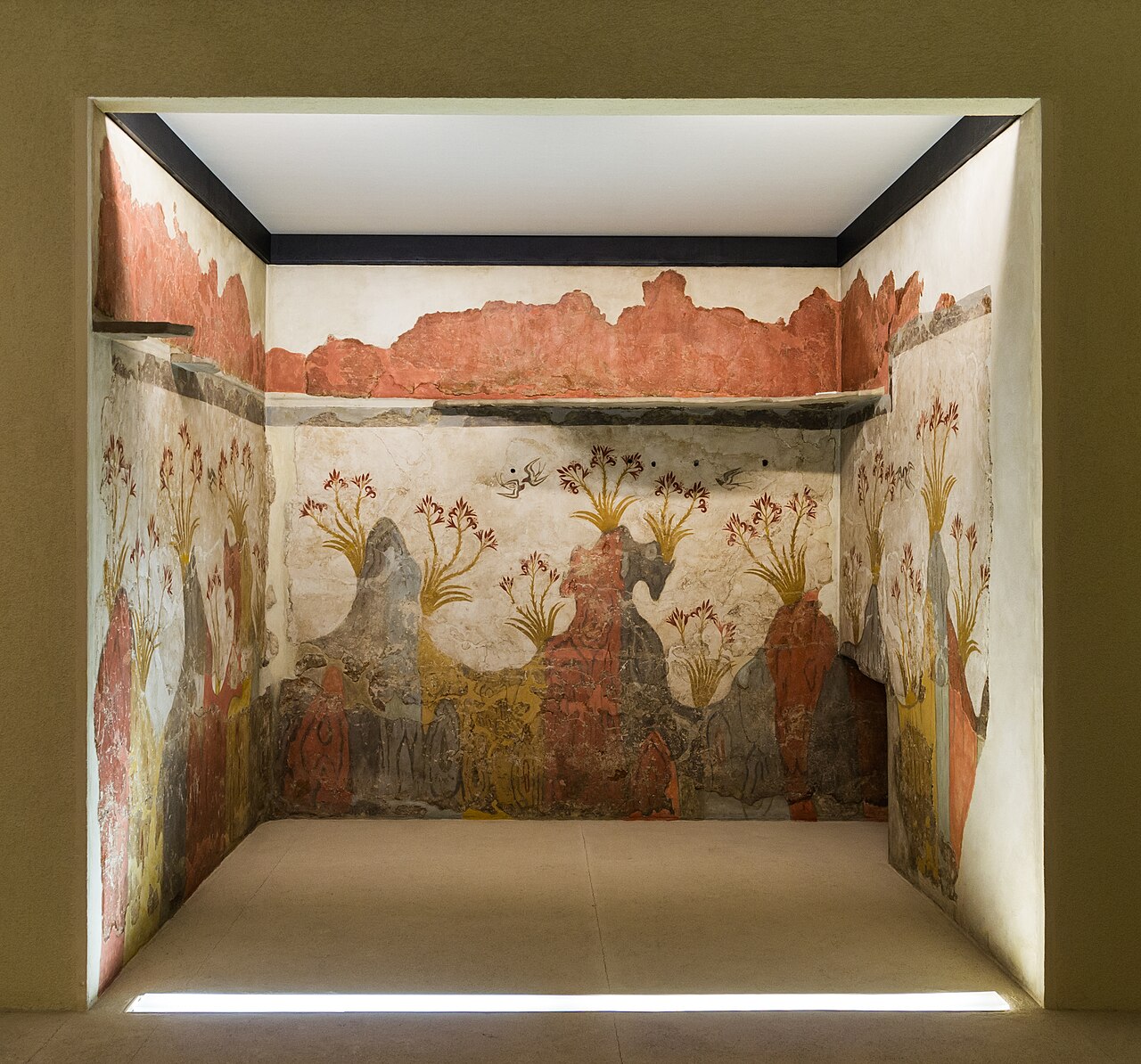
The frescoes of Santorini are not simply the work of one artist but a whole world, carrying us back to the Minoan age — the seventeenth century BC. On the island of Thera, better known today as Santorini, they were painted in the town of Akrotiri, which was buried under volcanic ash. That catastrophe is precisely what preserved these unique works of art, and they now offer us a picture of everyday life in the Aegean world.
The most famous among them are the Boxing Boys, the Saffron Gatherers, and the Flotilla. These are not merely beautiful images but whole stories — of how people lived, what they did, what they honored and valued. The Boxing Boys shows a spectacle popular in the ancient Greek world; the Saffron Gatherers reveals the weight that plant carried in the early economy; the Flotilla carries us into the world of seafaring and trade on which the Minoan economy rested.
Masterpieces though they are, the frescoes also carry essential ideas about Minoan civilization: its social order, its economy, its culture and customs. Through them we can grasp how the people of that era lived, worked, and dealt with one another. They are less paintings than windows onto the past, opening a clearer view of our common history.
The fate of the Santorini frescoes is itself remarkable. Because Akrotiri lay buried under ash, they survived for thousands of years — yet the same event destroyed the town and its inhabitants, preservation and annihilation in a single stroke. It is a reminder of the fragility of human life, and of why our cultural heritage deserves safeguarding.
The frescoes of Santorini matter today because they give us a picture of our common past and cultural inheritance. They show how people lived and dealt with one another in the ancient world, and how traditions and values passed from one generation to the next. They also move us to protect that inheritance and to study history, the better to understand the world and our place in it. They are not merely works of art but a genuine treasure of human history and culture.