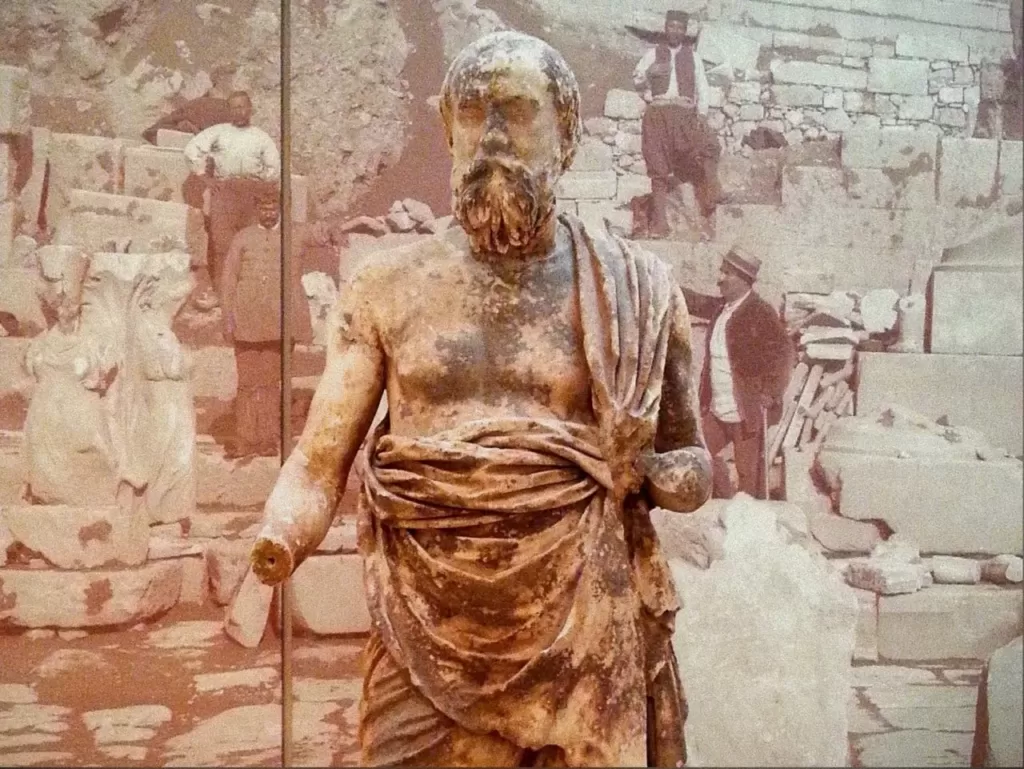
The details of Plutarch's life are imperfectly known. The date of his birth is not established with certainty, but it is usually placed in the middle or second half of the 40s AD. He was born and raised in Chaeronea, a small town of ancient lineage in Boeotia, some hundred kilometres north-east of Athens. His family was well-to-do, though it did not belong to the old aristocracy; its members were noted for their education as well as their means. Plutarch received a good schooling and knew the classics of Greek literature. At about twenty he went to Athens to study under Ammonius, an Alexandrian philosopher of the Platonic (Academic) school; he mentions that during those years he befriended a descendant of Themistocles.
In 66-67 or 67-68 the emperor Nero toured Greece, and Plutarch saw him at Delphi. After the civil war of 68-69 — the Year of the Four Emperors — an embassy was dispatched to the new emperor Vespasian at Alexandria, and Plutarch may have been among its members.
Some time after completing his studies, Plutarch returned to his native Chaeronea — a fact that sets him apart from most Greek intellectuals, who preferred to live and work in the great cultural centres. In Chaeronea he held the office of eponymous archon and other local magistracies. He was deeply attached to Chaeronea and to Boeotia; one mark of his particular interest in local history is his detailed account of the activities of Lucius Licinius Lucullus in Boeotia — an episode of great moment for Chaeronea, however slight its place in the wider world. Young men gathered at his house, and he instructed them in philosophy and the other sciences. Around his fiftieth year, in the late 90s, he was chosen as one of the two lifetime priests of the temple of Apollo at Delphi, and having assumed that honoured post he made a point of celebrating the sanctuary in his writings. He was also initiated into the mysteries of Dionysus and, possibly, of Isis.
Plutarch travelled widely, above all through Greece. He visited many historic sites, Thermopylae and Sparta among them, and the fields of many famous battles; his powers of observation show most vividly in his detailed account of the battle between Sulla and Archelaus at Chaeronea in 86 BC. He also ventured beyond the Roman province of Achaea, to Macedonia, Crete, Italy, Egypt and Asia Minor. He was in Rome more than once — scholars commonly reconstruct two stays in the capital, in the late 70s and the early 90s. The occasion for the first journey was a lawsuit involving the Boeotians or the Delphians, though he doubtless seized the chance to make connections in the capital. Besides Rome he saw other parts of Italy, including the site of the battle of Bedriacum, and delivered several public lectures on philosophy there — in Greek. It is possible that his last visit to Italy was cut short by Domitian's expulsion of the philosophers.
He may have met Lucius Mestrius Florus, an associate of Vespasian, while serving in the embassy to the new emperor, though the acquaintance may equally have begun in Greece. Florus became Plutarch's patron, and through him the Greek writer received Roman citizenship under the name Lucius Mestrius Plutarchus. His other Roman friends and acquaintances were likewise men of considerable influence: Quintus Sosius Senecio, twice consul; Titus Avidius Quietus, suffect consul and proconsul of Achaea; Gaius Avidius Nigrinus; a certain Saturninus, identified with the suffect consul Lucius Herennius Saturninus; Gaius Minicius Fundanus, a suffect consul who corresponded with Pliny the Younger; and Sextius Sulla of Carthage. Among his acquaintances were also men directly connected with letters and the arts: Quintus Junius Arulenus Rusticus, suffect consul and writer, put to death by Domitian; Julius Secundus, a great orator of the late first century and teacher of Tacitus; Terentius Priscus, identified with the patron of the poet Martial; and Aufidius Modestus, the probable author of commentaries on Virgil's Georgics. He also knew Philopappus, a descendant of the royal house of Commagene, who became suffect consul of the Roman empire in 109. To his influential Roman friends Plutarch dedicated a number of philosophical treatises; the Parallel Lives he dedicated to Quintus Sosius Senecio, and the Sayings of Kings and Commanders, probably, to the emperor Trajan.
Plutarch knew Latin, but by his own admission began reading books in that language only in maturity, and confessed that he had lacked opportunity to practise it during his travels in Italy.
His last years are known only from unreliable late sources. A brief entry in the Byzantine encyclopedia known as the Suda reports that Trajan invested him with consular rank and granted him something like a right of veto over all the acts of the governor of Illyricum. Eusebius of Caesarea adds that in 119 Plutarch became "procurator" of Achaea. That his own writings never mention these high honours may be explained either by the earlier composition of his principal treatises or by the greater weight he attached to a place within traditional Greek civic life. He died after 119; his death is usually assigned to the 120s. According to Artemidorus, he was gravely ill at the end of his life. Scholars who doubt the accuracy of Eusebius's report date his death after the inscription made in his lifetime on a statue at Delphi, set up soon after 117, when Hadrian had only just come to power.