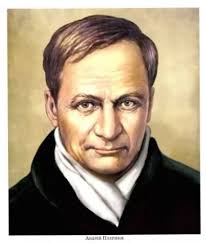
Andrei Platonov — real name Andrei Platonovich Klimentov — was a Russian Soviet writer and playwright, and in style and language one of the most singular Russian authors of the first half of the twentieth century. He was born on 16 (28) August 1899 in Voronezh. His father, Platon Firsovich Klimentov, was an engine driver and metalworker in the Voronezh railway workshops; twice he was named a Hero of Labour (in 1920 and 1922), and in 1928 he joined the Party. His mother, Maria Vasilyevna Lobochikhina, a watchmaker's daughter and housewife, bore eleven (or ten) children, of whom Andrei was the eldest. She gave birth nearly every year, and Andrei, as the firstborn, shared in raising — and later in feeding — all his brothers and sisters. Both parents lie in the Chugunovskoye cemetery in Voronezh.
In 1906 he entered a parish school, and from 1909 to 1913 attended a four-year city school. From 1913 (or the spring of 1914) until 1915 he worked as a day labourer and for hire: as an office boy at the Rossiya insurance company, as an assistant driver on a portable steam engine at the estate of Colonel Bek-Marmarchev. In 1915 he was a foundry worker at a pipe factory, and from the autumn of 1915 until the spring of 1918 he passed through many Voronezh workshops — millstone-making, casting, and the like.
In 1918 he entered the electrical engineering department of the Voronezh Polytechnic Institute, and served on the main revolutionary committee of the South-Eastern Railways and on the editorial staff of the journal The Iron Road. He took part in the Civil War as a front-line correspondent. From 1919 he was publishing his own work, contributing to several newspapers as poet, essayist and critic. In the summer of 1919 he travelled to Novokhopyorsk as a correspondent for the Izvestia of the Defence Council of the Voronezh fortified district. Soon afterwards he was mobilized into the Red Army, working until the autumn as an assistant driver on a locomotive hauling military transport, and was then transferred to a railway detachment of a Special Purpose Unit (ChON) as an ordinary rifleman.
In the summer of 1921 he completed a one-year provincial party school. That same year his first book appeared — the pamphlet Electrification — along with poems in the collective anthology Verses. In 1922 his son Platon was born, and his book of poems The Blue Depth was published in Krasnodar; the same year he was appointed chairman of the provincial commission for hydrification under the land department. In 1923 Bryusov responded warmly to the poems. From 1923 to 1926 Platonov worked across the province as a land-reclamation engineer and specialist in the electrification of agriculture — heading the electrification section of the provincial land administration and building three power stations, one of them in the village of Rogachyovka. In the spring of 1924 he took part in the First All-Russian Hydrological Congress, conceiving schemes for the hydrification of the region and plans for insuring harvests against drought. That same spring he again applied to join the Russian Communist Party (Bolsheviks) and was accepted as a candidate by his cell, but never became a member. In June 1925 came his first meeting with Viktor Shklovsky, who had flown to Voronezh on an Aviakhim aeroplane to publicize the achievements of Soviet aviation under the slogan "Face to the Countryside." In the 1920s he changed his surname from Klimentov to Platonov — a pen name formed from his father's first name.
In 1931 the publication of For Future Use drew sharp attacks from Fadeyev and from Stalin himself. The writer was allowed to catch his breath only when RAPP was itself flogged for its excesses and disbanded. In 1934 Platonov was even included in a collective writers' expedition to Central Asia — by then a mark of a certain trust. From Turkmenistan he brought back the story Takyr, and the persecution began again: on 18 January 1935 Pravda ran a devastating article, after which the journals once more stopped taking his work and returned pieces already accepted. In 1936 the stories Fro, Immortality, The Clay House in the District Garden, The Third Son and Semyon appeared, and in 1937 the novella The River Potudan.
In May 1938 the writer's fifteen-year-old son was arrested; through the efforts of Platonov's friends he returned from imprisonment in the autumn of 1940, incurably ill with tuberculosis. Nursing him, Platonov caught the disease himself, and carried it from then until his death. In January 1943 the son died. During the Second World War Platonov served, with the rank of captain, as a war correspondent for Krasnaya Zvezda, and his war stories appeared in print; there is a view that this happened with Stalin's personal permission. At the end of 1946 his story The Return (The Ivanov Family) was published, and for it, in 1947, he came under attack and was accused of slander. In the late 1940s, denied the chance to earn his living by writing, Platonov occupied himself with literary reworkings of Russian and Bashkir folk tales for children's magazines. His outlook had travelled from faith in the remaking of socialism to an ironic vision of the future. He died of tuberculosis in Moscow on 5 January 1951 and was buried in the Armenian Cemetery. He was survived by a daughter, Maria Platonova, who prepared her father's books for publication.