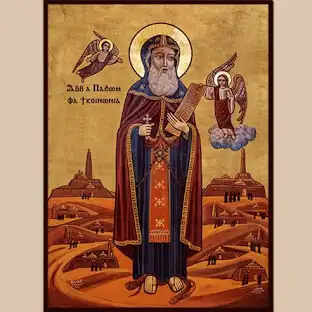
Pachomius the Great (c. 290–346) was one of the founders of Christian monasticism and the creator of its first communal rule. Born in Egypt, he became known as a reformer of the monastic life.
He was born into a pagan family but embraced Christianity as a young man. He began his spiritual life as a solitary monk, yet soon came to see the need for monasticism lived in community.
Around 320 Pachomius founded the first monastery at Tabennisi, in what is now Egypt. It became the model for others, and a monastic community soon gathered around it.
Pachomius drew up a rule to govern the life of monks in common. Its provisions wove together prayer, labour, obedience and brotherly love — principles that would become the foundation for many monasteries to come.
His teaching had a profound influence on the development of monasticism within Christianity. His ideas about the shared life of monks and the organisation of monasteries were taken up and developed by later ascetics, among them Benedict of Nursia.
Pachomius the Great is venerated as a saint in both the Orthodox and the Catholic Church. His feast falls on 15 May in the Julian calendar, 28 May in the Gregorian.