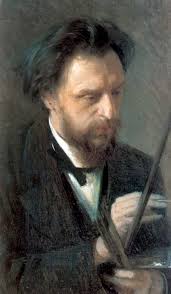
Grigory Myasoedov studied at the Oryol gymnasium but left without completing the course, entering the Academy of Arts as a student under the professors T. A. Neff and A. G. Markov. In 1861 he won the small gold medal for the painting Congratulating the Newlyweds.
Sent abroad at state expense, Myasoedov worked in Paris, Florence, Rome, and Spain. On his return to Russia he was made an Academician in 1870 for the painting Incantations. He was among the founders and most active figures of the Society for Traveling Art Exhibitions — the Peredvizhniki — taking part in every one of its shows and watching constantly over its independence and vitality.
Myasoedov was the son of a small landowning nobleman, and his father encouraged an interest in art that declared itself early. After the gymnasium in Oryol, where drawing was taught by the professional artist I. A. Volkov, the young man went to St. Petersburg and in 1853 entered the Academy of Arts. The decade he spent within its walls (1853-63) coincided with a grave crisis at the institution, one that ended in the "Revolt of the Fourteen" — though the revolt itself Myasoedov did not witness: by then he had finished the Academy and was abroad as its pensioner (1863-68), visiting Berlin, Brussels, Paris, and the cities of Italy and Spain.
While still a student he painted the genre picture Congratulating the Newlyweds in the Landowner's House (1861) and a canvas on a historical subject, The Flight of Grigory Otrepyev from the Tavern on the Lithuanian Border (1862), which Vladimir Stasov called one of the first bids toward a realist historical painting. Historical subjects would occupy Myasoedov's art constantly thereafter, side by side with scenes of everyday life — two lines of work that drew very close together and at times passed into one another.
All the while, his painting went hand in hand with public activity. It was Myasoedov who first proposed an artists' organization of a new type — the Society for Traveling Art Exhibitions. The idea had come to him as early as 1867, when, being abroad, he could watch European artists mounting traveling exhibitions, held chiefly for commercial ends. On December 16, 1870, the Society's first general meeting elected a board that included Myasoedov, together with Ivan Kramskoy, Nikolai Ge, Vasily Perov, and Mikhail Klodt; and on November 29, 1871, the First Traveling Art Exhibition opened in St. Petersburg, moving afterward to Moscow, Kiev, and Kharkov. To it Myasoedov contributed The Grandfather of the Russian Fleet (Peter the Great's Boat) (1871), a historical theme handled in a domestic key.
In March 1872 the Second Traveling Exhibition opened, and with it Myasoedov's most significant canvas, The Zemstvo Dines (1872). A quiet provincial town; a sunlit noon; by the entrance to the zemstvo offices, a knot of peasants. One, settled on the stone flags with his knapsack for a pillow, dozes; the others eat without hurry — bread and salt and onion are their whole dinner. Meanwhile, in the house, the gentlemen have just finished dining: through an open window a footman can be seen diligently washing up amid a clutter of bottles and decanters. The critical subject is plain to see — zemstvo gentry set against zemstvo peasants, wealth against poverty — but that was not what mattered most to the painter. He fixed his whole attention on the peasants themselves, discerning and capturing in them a diversity of characters, a particular comeliness, an inner composure, a beauty all their own.
Another of his major canvases, Reading of the Manifesto of February 19, 1861 (1873), opens a different aspect of the same theme: the fate of a peasantry cheated of its hopes. "I confess," one critic wrote, "that not since Repin's Barge Haulers have I seen in any picture faces so typical, so artlessly truthful, so lifelike, so genuinely peasant." The peasants listen with concentrated attention as a boy reads out the manifesto on emancipation from serfdom. Their attitude to the document has not yet taken shape: the faces show neither joy nor open disappointment, but an inner tension, a distrust, a wariness. These peasants are, in their own fashion, wise and courageous.
The study of Russian peasant life led Myasoedov to subjects drawn from ancient beliefs and customs and their role in the life of the people. The Ritual Ploughing (1876) shows an old rite: to ward off evil spirits, the peasants plough a furrow around the village, harnessing naked girls to the plough. In 1878-80 he worked on two versions of Drought, with its prayer service in the fields; and in parallel he kept up his search in historical subjects, painting The Self-Immolators (1882-84), whose theme is bound very closely to the genre pictures that preceded it.
By the early 1880s a new stage was opening in Myasoedov's art. The landscape Road Through the Rye (1881) strikes one by the simplicity and expressiveness of its motif — a lone wanderer receding toward the horizon through a boundless field of rye — as if the painter had discovered the possibility of a more generalized, monumental treatment of the genre picture. That possibility found its fullest expression in The Mowers (1887), a celebration of the joyful side of existence and of the beauty of peasant labor, its measured, concerted, almost musical rhythm; the very dimensions of the canvas (159 by 275 cm) attest to how much the theme meant to him. Yet the solution was not without its contradictions. In wholly renouncing the critical impulse, Myasoedov renounced the governing principle of the artistic system of the 1870s; and having mastered no new pictorial language, unprepared to receive the ideas of the younger generation of painters, he found himself among those members of the Society who, at the turn of the 1880s and 1890s, refused to admit young artists to their ranks. The last years of his life added nothing essential to his work.