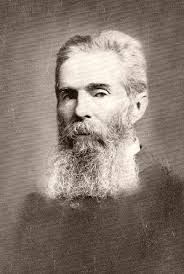
Melville was born in New York. He was twelve when his father, a merchant, died, leaving debts behind and putting an end to any thought of a university education. From eighteen he sailed as a cabin boy on a packet ship, then taught school for a time; in 1841 he shipped out for the South Seas aboard the whaler Acushnet. A year and a half later, after a quarrel with the ship's boatswain, he deserted near the Marquesas Islands, was taken captive by the islanders, and was later freed by the crew of an American warship. After three years of wandering he came home to take up literature.
The novels drawn from his own experience — Typee: A Peep at Polynesian Life and Omoo: A Narrative of Adventures in the South Seas — made him famous at once (Typee remained the most popular of his books in his lifetime). They are marked by a flight into the exotic, a complete refusal of the reality familiar to the reader: Melville carries his hero off into a primitive world, among South Sea islanders untouched by civilization. Behind the engaging plots lies a question that troubled more minds than Melville's: can one renounce civilization and return to nature?
Mardi: And a Voyage Thither, an allegorical novel of a voyage as a philosophical quest for the Absolute, met with no success. In the books that followed, still working from personal experience, Melville set out to analyze the world around him and its social relations. He wrote Redburn: His First Voyage and White-Jacket; or, The World in a Man-of-War — the latter a picture of the evil and cruelty of the military of his day.
Then he abandoned the realistic sea novel and wrote his masterpiece, Moby-Dick; or, The Whale, proclaiming the primacy of the irrational. In Moby-Dick Melville argues the irrationality of social relations; he paints a fantastically dark reality ruled by a mysterious white whale named Moby Dick, whom almost no one has seen but who makes himself known by "the results of his actions." Moby Dick holds sway over everything; rumor has it that he is everywhere at once (perhaps he stands for God, or for the devil). The great majority of Melville's contemporaries failed to appreciate the book.
A year later came the Gothic novel Pierre; or, The Ambiguities — its hero a writer who feels as alone amid a noisy crowd as at the pole — and after the drubbing it received, Melville published anonymously, placing stories in magazines; many of them were gathered in The Piazza Tales. A year before that collection, the historical novel Israel Potter: His Fifty Years of Exile had appeared. His last novel was The Confidence-Man: His Masquerade, a biting satire on human credulity, set aboard the Fidèle as she sails down the Mississippi.
The money earned chiefly by the early books still held out, and in 1860 Melville sailed around the world. From 1866 to 1885, however, he served as a customs officer. He went on writing, but died all but forgotten. Only an anonymous obituary spoke of an "exceptionally gifted author" possessed of "a powerful poetic imagination."