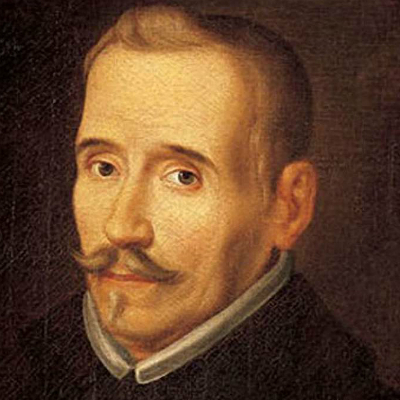
He was born in Madrid on 25 November 1562, the son of a craftsman who embroidered in gold. His gifts declared themselves early: at ten he made a verse translation of Claudian's Rape of Proserpina. He studied at the university of Alcala, and his ballads brought him immediate fame; in them, as in every genre he touched, Lope saw the embodiment of his aesthetic ideal, according to which Nature must always stand above Art.
The university he never finished. For a satire on the family of a mistress who had rejected him he was sentenced to ten years' banishment from Madrid — and returned to the capital regardless, to abduct a new lady of his heart and marry her in secret. The episode left its trace in his crowning work, the dialogue novel Dorotea (1634), in writing which the dramatist drew on Eufrosina, a prose comedy by Jorge Ferreira de Vasconcelos.
In 1588 he sailed with the Invincible Armada; after its defeat he settled in Valencia, where he wrote a series of plays to support his family. He served as secretary to the Duke of Alba (1590), the Marquis of Malpica (1596) and the Duke of Lemos (1598) — the years in which his dramatic genius flowered. He took an energetic part in mounting lavish theatrical festivities at court. Courtly life, hints of love affairs, his own feelings and those of people he knew, and his grief at the death of his first wife, Isabel de Urbina (1594), supplied the substance of his pastoral novel Arcadia (1598).
In 1598 he married Juana de Guardo, daughter of a wealthy merchant; but from 1599 to 1608 the chief place in his life belonged to the actress Micaela de Lujan — the Camila Lucinda of his verse and prose. In a period of grave spiritual crisis he broke the liaison off.
In 1609 he became a voluntary servant of the Inquisition, receiving the title of familiar del Santo Oficio de la Inquisicion. His state of mind was darkened by a succession of deaths — his beloved son Carlos Felix in 1612, his wife in 1613, and then Micaela. The testimony of that inner drama is the collection Sacred Verses, published in 1614.
In 1616 he met his last love, the twenty-year-old Marta de Nevares, whom he celebrated in verse and prose under various names — Amarilis, Marcia Leonarda — and to whom he dedicated one of his finest comedies, The Widow of Valencia (1604, reworked in 1616–18), as well as the novellas The Adventures of Diana (1621), The Martyr of Honour, Prudent Revenge and Guzman the Bold.
His last years were a chain of personal catastrophes. In 1632 Marta died, having gone blind and lost her reason two years before; the same year his son perished on a sea voyage, and his daughter was carried off by a lover. Yet his writing never stopped, not for a single day. He died in Madrid on 27 August 1635.
Among his plays: La discreta enamorada (The Ingenious Lover), La villana de Getafe (The Peasant Girl of Getafe), El mejor alcalde, el rey (The Best Magistrate, the King), Fuenteovejuna (The Sheep Well) — on which the ballet Laurencia was later based — Peribanez y el comendador de Ocana, and He Who Went Away Stayed at Home. Several of his comedies, among them The Dancing Master, The Dog in the Manger and The Lady Simpleton, have been adapted for the screen.