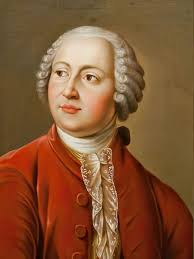
Mikhail Vasilyevich Lomonosov (8 [19] November 1711, village of Mishaninskaya, Russia – 4 [15] April 1765, St Petersburg) was the first Russian natural scientist of world stature — an encyclopedist, a chemist and a physicist. He entered science as the first chemist to give physical chemistry a definition remarkably close to the modern one, and he sketched out an ambitious programme of physico-chemical research. His molecular-kinetic theory of heat anticipated in many respects the modern understanding of the structure of matter, together with a number of fundamental laws — among them one of the principles of thermodynamics. He also laid the foundations of the science of glass.
The range was astonishing: astronomer, instrument-maker, geographer, metallurgist, geologist and poet, he established the foundations of the modern Russian literary language; he was besides an artist, a historian, and a champion of national enlightenment, science and economic development. He drew up the project for Moscow University, later named in his honour, and he discovered that the planet Venus possesses an atmosphere. He was a full member of the Academy of Sciences and Arts — adjunct of the physics class from 1742, professor of chemistry from 1745.
The outline of his life can be followed almost year by year. On 7 December 1730 he obtained a passport from the voevoda's chancellery at Kholmogory, and around 15 December he set out on foot for Moscow. On 15 January 1731 he was enrolled as a pupil of the Slavonic-Greek-Latin Academy in Moscow, where he studied until 1735, spending part of 1734 at the Kiev-Mohyla Academy. On 12 January 1736 he was admitted as a student of the Academic University in St Petersburg, and on 4 October of the same year he was sent to Germany to study mining and metallurgy.
From 1736 to 1739 he studied at the University of Marburg; from January 1737 he attended Professor Christian Wolff's course in mechanics and Professor J. G. Duising's course in theoretical chemistry. In February 1739 he married his landlady's daughter, Elisabeth-Christine Zilch; on 8 November of that year a daughter was born to them, baptized the following day in the church of the Reformed community under the name Catherine-Elisabeth. In 1739–1740 he studied mining under J. F. Henckel, and on 26 May 1740 he was formally wedded to Elisabeth-Christine Zilch in the Reformed church of Marburg.
At the end of May 1740, making his way homeward, he “appeared to the Prussians a fish fit for their hook” near Düsseldorf and was tricked into their ranks as a recruit; in October he escaped, made his way through Arnhem and Utrecht to Amsterdam, then on to The Hague, and only after returning once more to Amsterdam did he take ship for Russia. On 8 June 1741 he was back in St Petersburg; on 22 December of that year a son, christened Ivan, was born to him in Marburg.
On 8 January 1742 he was appointed adjunct of the physics class of the Academy of Sciences and Arts, and on 25 July 1745 professor of chemistry. On 20 June 1746 he delivered public lectures on physics in Russian for the first time. In 1748 he created the first research and teaching Chemical Laboratory in Russia, and from 1748 to 1757 he carried out there his work on the making of coloured glass and pigments and on the analysis of ores. On 21 February 1749 his daughter Elena was born. In 1752–1753 he gave in the Chemical Laboratory the first course of lectures on physical chemistry in history, and in 1753 a glassworks was founded at the village of Ust-Ruditsa.
In 1755 Moscow University was established according to Lomonosov's project. In 1757 he was appointed Counsellor of the Academic Chancellery, and in 1758 he became head of the Historical Assembly, of the Geographical Department, and of the Academy's university and gymnasium. On 30 April 1760 the Royal Swedish Academy of Sciences elected him an honorary member; on 10 October 1763 he was elected a member of the Academy of the Three Noblest Arts, for his work in mosaics; and in April 1764 he became an honorary member of the Academy of Sciences of the Bologna Institute. On 4 April 1765 he died in his own house on the Moika, and on 8 April he was buried in the Lazarevskoye cemetery of the Alexander Nevsky Lavra.
Bibliography: Notes on Russian History. Principal works on language: the Russian Grammar; the Preface on the Utility of Church Books in the Russian Language; the Rhetoric; the Report on His Labours for 1755.