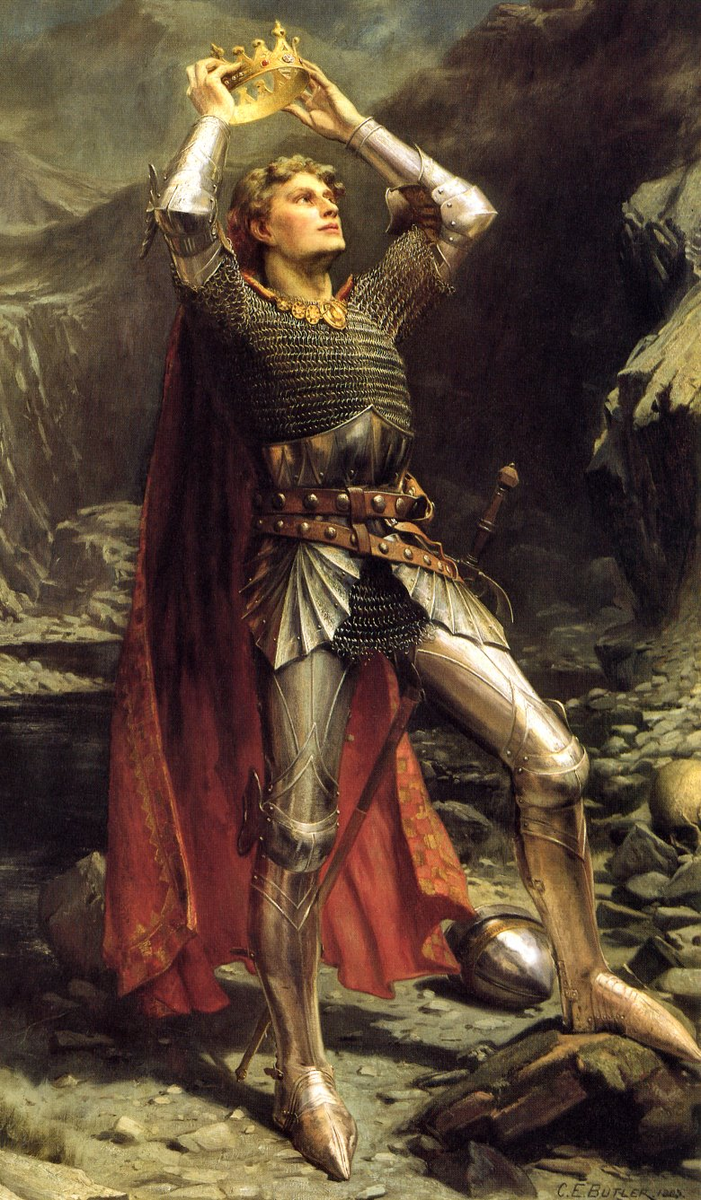
The British war-leader Arthur has had an astonishing posthumous career. The historical chronicles spare him only a few lines, yet Welsh and Breton tradition not only preserved his name but furnished his biography with details borrowed from the ancient mythology of those peoples. The dux bellorum of the chronicles became the Once and Future King, with traits of a pagan divinity — at first only in Wales and Brittany, where a Celtic population survived after the Saxons had driven it from most of the island of Britain; then his fame spread far beyond Britain, and it resounds throughout the world to this day. Writers, poets, painters and film-makers show no sign of losing interest in the story.
The historical Arthur held back the Saxon advance at the turn of the fifth and sixth centuries. We know of this from the History of the Britons by Nennius, a Welsh chronicler who lived three centuries later. "After the death of Hengist," the chronicle says, "his son Octa moved from the left side of Britain to the kingdom of the Kentishmen, and from him descend the kings of Kent. In those days the war-leader Arthur fought against them together with the kings of the Britons, and he was the leader in battle." There follows a list of Arthur's twelve battles against the Saxons, among them the battle of Mount Badon, and then the summing-up: "In all the said battles he had the upper hand. And the Saxons, being worsted in every one of them, sought help from Germany and increased continually in numbers, calling in kings from Germany to reign over them in Britain; and so it continued until the time when Ida, son of Eobba, reigned: he became the first king of the land of Bernicia." Arthur and the battle of Mount Badon are mentioned still more briefly in the Annals of Cambria, compiled at the end of the tenth century. There are also several Welsh ballads in which the name of the war-leader Arthur sounds; the author of one of them, it is thought, may have been a contemporary of the events. Gildas, in his treatise On the Ruin of Britain (mid-sixth century), records the British victory at Mount Badon but not the commander's name. Not much, as we can see. Yet the archaeological evidence confirms that the Saxon advance across the island did pause at just this time.
The oldest literary work known to us in which a King Arthur — a king, not a commander — appears is the Welsh tale of Culhwch and Olwen, a very popular composition whose earliest surviving copy belongs to the thirteenth century, though on linguistic grounds the text itself is assigned to the eleventh, perhaps even the tenth. The plot turns on the young Culhwch's wooing of the beautiful Olwen, daughter of a ferocious giant. To win her hand Culhwch must perform forty tasks of the utmost difficulty and wonder. Unable to manage alone, he comes to Arthur's court to seek help and counsel of the king and his warriors; together they accomplish the giant's tasks, and the youth gains his bride. Arthur here is a secondary figure — and his very appearance in such a role, secondary though it is, shows that by then a developed Arthurian tradition already existed. The audience knew perfectly well who was meant. That tradition, alas, has not come down to us.
The oldest surviving written monument to tell a connected story of Arthur's accession, reign and death is the history of Geoffrey of Monmouth, written in the 1130s — some seventy years, that is, after the Norman Conquest. It cannot, however, simply be called a book about King Arthur. This pseudo-chronicle runs from the mythical founding of the British kingdom by Trojan refugees (everyone, for some reason, wished to descend from Trojan refugees) down to the Saxon conquest. Yet the story of Arthur takes up a disproportionate share of it — about a third of the whole.
Perhaps the nearest analogue to Geoffrey's History in modern literature is Tolkien's Silmarillion: an imitation historical chronicle whose matter is drawn from legend or from the author's own abundant imagination. Unlike Tolkien, though, Geoffrey did not remove the action to a fantastic parallel world; he filled in the dark places of the real historical record. How do we know? Many of the events he describes were too large to have passed wholly unnoticed, yet no independent source, written or archaeological, confirms them. In a number of cases Geoffrey did lean on solid authorities — he certainly used Nennius, and the events surrounding the Saxons' first appearance in Britain are described very similarly in both books. But much in Geoffrey is confirmed by no other source, and some of it flatly contradicts them.
Geoffrey's History achieved a popularity incredible by medieval standards: more than two hundred manuscript copies survive — how many there once were, one can only guess. A short extract, the Prophecy of Merlin, circulated separately and was more popular still. A prophecy delivered during a battle between a red Celtic and a white Saxon dragon occurs, incidentally, in Nennius too — only there the combatants are serpents, not dragons, the prophet is not called Merlin, and the text is far shorter and more intelligible.
Of Geoffrey himself not much is known. He was probably a Welshman. In the byname "of Monmouth" scholars incline to see his birthplace, a town in south-east Wales which had once distinguished itself by stubborn resistance to the Anglo-Saxon advance — and which resisted the Normans too, for that matter. Yet we do not even know for certain what exactly connected the author to that town. What is certain is that in 1129 he held some post in a monastic school at Oxford, and that he had high patrons among the Norman elite: some copies of his book are dedicated to King Stephen of Blois, grandson of William the Conqueror, others to Robert of Gloucester, an illegitimate scion of the royal house.
A word is in order here about the Normans' relations with the descendants of the British Celts whom the Saxons had displaced. Many of those Celts had found refuge in Brittany — hence the name, Little Britain. William the Conqueror's army included a contingent of Bretons, and a very effective one. With the Welsh matters were more complicated: for a long time they successfully defended their independence against Saxons and Normans alike. But on the whole the new Norman aristocracy's attitude to the British Celts was rather friendly. Their hostility toward the old Anglo-Saxon conquerors was something the new conquerors knew how to use.
The unheard-of success of Geoffrey's History must of course be credited largely to the fact that the book answered the tastes of the medieval reader and was written with talent. But the approval of the powerful should not be discounted either. The new elite needed something to set against the Anglo-Saxon Chronicle — hence the sudden flare of interest in a theme far beyond its usual geographical home. It is worth noting that the Prophecy of Merlin foretells not only the course of the war between Britons and Saxons but the coming defeat of the Saxons at Norman hands: the white dragon is to be destroyed by a wind from the north.
The Arthurian myth drew a second breath under the first Plantagenets. King Henry II decided that his subjects needed a great past; to seek it in recent history, where every claim had been staked by Saxons who still glowered at the Norman aristocracy, was awkward — whereas Arthur, who had fought the Saxons with success, suited perfectly. Henry named his first grandson Arthur. It was then, too, that the grave of Arthur and Guinevere was "discovered" at Glastonbury Abbey. The story Geoffrey told held the indeterminate status of a legend founded on real events, and even in the Middle Ages it met with a certain scepticism.
In the thirteenth and fourteenth centuries the Arthurian matter shed its national and political accents. French romancers took up the story, and in their hands the time and place of the action are hard to catch. Everything happens, as one might say, once upon a time in a kingdom far away — or, as the title sequence of one English television series has it, "in a land of myth and a time of magic." The theme of resistance to invaders recedes; what matters now is the brotherhood of the Round Table and its members' personal exploits, and the ladies claim an ever larger share of the stage.
In the fifteenth century a veteran of the Wars of the Roses, Sir Thomas Malory, made an outstanding contribution to the Arthurian cause. Malory led a very stormy life that left little leisure for literature; but he fought on the Lancastrian side, and after its defeat he found himself in prison. There the leisure appeared. Sir Thomas spent it writing a thick book — a series of chivalric romances gathered under the title Le Morte d'Arthur. It draws fully on the French tradition, but the hero is returned to English soil; and in Malory's hands the horror of civil strife that destroyed the king and his knights sounds with a new force. Who should have known it, if not he?
Le Morte d'Arthur became a classic, and one of the first secular books ever issued from a printing press. Those who took up the Arthurian theme afterwards drew their inspiration, as a rule, precisely from Malory. Geoffrey is, after all, too archaic.
"Willows whiten, aspens quiver,
Little breezes dusk and shiver
Thro' the wave that runs for ever
By the island in the river
Flowing down to Camelot."
— Alfred Tennyson
For eight hundred years now the story of King Arthur, the wise enchanter Merlin and the valiant Knights of the Round Table has ranked among the most sought-after subjects of imaginative culture. Eight hundred years, that is, can be vouched for; beyond that its origins are lost in the dark of the ages, where reliable written sources fail us, and the fortunes of an oral tradition are very hard to trace.
The cycle of Arthurian romances printed in 1485 under the general title Le Morte d'Arthur was one of the world's first secular works of fiction issued in what was, for the time, a mass edition. It was not entirely clear at the time how the book should be taken — as entertaining reading, or as a serious historical chronicle. William Caxton, the first English printer, who prepared the edition, supplied it with a preface in which he wrote: "After that I had accomplished and finished divers histories, as well of contemplation as of other historial and worldly acts of great conquerors and princes, and also certain books of ensamples and doctrine, many noble gentlemen of this realm of England came and demanded me, many and ofttimes, wherefore I have not made and imprinted the noble history of the Saint Greal, and of the most renowned Christian king, first and chief of the three best Christian and worthy, King Arthur, which ought most to be remembered among us Englishmen before all other Christian kings... To whom I answered that divers men hold opinion that there was no such Arthur, and that all such books as be made of him be but feigned and fables, because that some chronicles make of him no mention, nor remember him nothing, nor of his knights. Whereto they answered, and one in special said, that in him that should say or think that there was never such a king called Arthur might well be aretted great folly and blindness; for he said that there were many evidences of the contrary."
It must be said that the proofs adduced by the aforesaid gentleman are no longer found convincing. They were chiefly relics kept in various monasteries — plainly fabricated to attract pilgrim-tourists, as people already suspected in Caxton's day. But that did not diminish the legend's charm. On mature reflection the printer decided to heed his prospective readers. His choice fell on the cycle of romances from the pen of a certain Sir Thomas Malory, who had died some fifteen years earlier in a London prison, where he had been confined as a partisan of the Lancastrian dynasty ousted from power by the Yorkists. It was there, by all appearances, that the romances were written; before Sir Thomas came to be locked up, his life had been too turbulent for sustained literary work.
Before Malory's book attracted Caxton's favourable notice it had already circulated, as widely as a manuscript can, in written copies. Nor was it, to put it mildly, the first popular work on the subject. Le Morte d'Arthur summed up a tradition many centuries old and became a kind of watershed between the medieval Arthurian literature and the new literature devoted to the same theme. Sir Thomas used the plots of numerous romances and poems written earlier, in the thirteenth to fifteenth centuries; but later writers turning to Arthurian matter most often took Malory's romances as their principal source of inspiration.
Not that anyone, in relating the reign of King Arthur, ever felt obliged to follow the sources with any accuracy. The Arthuriad exists in a multitude of versions and conceals countless cultural strata; their study has even produced a whole branch of cultural scholarship — Arthurian studies. Let us nevertheless attempt a generalized version of the legend.
In time immemorial Britain was ruled by King Uther Pendragon. His kingdom was ringed with enemies, and his life passed in battle. The king was brave but unbridled. One day he conceived a passion for the wife of one of his mightiest vassals, Duke Gorlois of Cornwall — the fair and virtuous Igraine. The offended duke left the court in haste with his wife and rose in revolt, while the king pined for the duchess and could think of nothing else. He turned for help to the famed magician and seer Merlin, who promised his aid on one condition: the child conceived on the first night the king spent with Igraine was to be given to him, Merlin, to rear.
Uther readily promised. Merlin then worked his spells and gave the king the likeness of Gorlois; in that shape he passed unhindered to the duchess in her husband's absence and spent a night of love with her. Meanwhile the real duke perished in a skirmish with the king's men. Uther was thus free to marry Igraine, so that Prince Arthur, conceived on that first night, was born in lawful wedlock. Mindful of his promise nonetheless, the king meekly surrendered the infant to Merlin, who brought him up far from the court.
The circumstances of Uther's death and Arthur's accession vary from one version of the legend to another, but the most popular agree that the fifteen-year-old Arthur proved his right to the throne by being the only claimant able to draw a miraculous sword from an enchanted stone, as Merlin had foretold. The young king's first years passed in war. A fearless warrior and an open-handed sovereign, he overcame all his enemies, united the once scattered lands under his high kingship, brought the realm a prosperity never seen before, and founded a magnificent new capital — Camelot. The most illustrious knights of Britain won the right to a seat at the Round Table set up in one of the halls of the royal castle; Arthur himself held that right as first among equals.
A large part of the Arthurian romances is devoted to the wanderings, single combats, battles with monsters and giants, and other wondrous exploits of the Knights of the Round Table, the best and noblest warriors of their age. The king himself figures as protagonist and direct participant in dangerous adventures by no means everywhere; in some works he gradually withdraws into the background, his role reduced more and more to that of a wise and just judge, while the heroes of the tale are others — the valiant knights Lancelot, Gawain, Gareth, Percival, Geraint, Tristan, Galahad and the rest. Often the knights are opposed by otherworldly powers and mighty sorcerers. A special place among these belongs to Morgan le Fay, King Arthur's sister, deeply versed in magic, tirelessly plotting against her brother and his faithful servants. In some versions Arthur has two malevolent sisters, Morgan and Morgause; scholars take this to be a mere doubling of one character, arising from variant pronunciations of a single name. There are also wizards well disposed toward Camelot — above all, of course, Merlin, and the Lady of the Lake, Nimue. Gradually the Arthurian cycle absorbed plots popular in the Middle Ages that had once been independent: such are the story of the quest for the Holy Grail and the tale of Tristan and Iseult, whose heroes became Knights of the Round Table only in relatively late literary versions.
Arthur becomes an active protagonist again in the works, charged with drama, that tell of Camelot's fall. In the most popular version, the first impulse that brought the glorious kingdom to so sad an end was the fatal passion that flared between Arthur's queen, Guinevere, and the most illustrious of his knights, Lancelot. Curiously, though, these two are not named the chief culprits of the catastrophe. More than that: even within a single source the question of whether Guinevere was actually guilty of adultery, or whether her relations with Lancelot remained purely platonic, is often treated in a muddled and contradictory way — to say nothing of the contradictions between different works. One frequently meets the version in which Arthur knew, or at least guessed, of the love binding two people so close to him, blamed neither, and would have preferred to resolve this delicate moral problem within a narrow circle of the parties concerned — but the choice was taken from him. A certain Mordred — in one version the king's nephew, in another his son by an incestuous union with his sister — came forward with a public accusation of the queen's infidelity. It is this guardian of moral purity who is the chief villain of the classical Arthuriad.
After Mordred's accusation Guinevere had to answer under the law, and the king, whatever his wishes, could not hush the matter up; Lancelot resolved to defend his beloved sword in hand. And since he had many devoted friends in Camelot, the end of it was that the Knights of the Round Table raised arms against one another for the first time. In the later course of events the queen's fate somehow slips into the background. In Malory's romance Lancelot actually returns her to the king, declaring himself ready to prove her innocence against all comers in trial by combat. On those terms no one cared to sustain the accusation, and the vindicated Guinevere resumed her place on the throne of Camelot — but it brought no peace. By then relations among the Knights of the Round Table were spoiled beyond repair; the old brotherhood had fallen apart. The main axis of the conflict now becomes the implacable enmity Gawain bears Lancelot, the accidental cause of his brothers' deaths. Arthur tried to reconcile them, in vain.
While this feud dragged on, the treacherous Mordred took advantage of the king's absence from Camelot to raise a revolt and attempt the throne. A multitude of knights perished in the fratricidal war. In the last battle Mordred and Arthur met in single combat and killed each other. Another ending, though, was also current: Mordred indeed died on the spot, run through with a spear, while Arthur received a mortal sword-wound yet did not die, but was carried for healing to the enchanted isle of Avalon, whither mortals ordinarily have no road. There he abides to this day, so that when the need for him comes he may return to the world of the living and defend England from her enemies.
In yet another variant the mortally wounded Arthur turned into a raven, and in that shape awaits his hour. It is with this legend, presumably, that one should connect the well-known belief that England will remain unconquered so long as ravens live in the Tower of London.
All of the above is something more than a fairy tale for a pleasant hour. In medieval Europe many believed not only in the reality of the great king of the past but in his future return; English even kept an idiom about waiting for a thing until Arthur's coming. And yet solid, educated people voiced well-founded doubts that a King Arthur had ever actually existed. It is doubtful, however, that such tales could have arisen out of absolutely nothing. Grant that Camelot as Sir Thomas Malory described it never existed: there was something else that gave the legend its start.
The Arthurian romances contain many cultural strata, and to make even a little headway through the layered pastry of the Arthurian myth one must refresh one's memory of the island's history.
In the earliest era for which any written reports survive, Britain was inhabited by Celtic tribes which had apparently crossed from the continent in the eighth and seventh centuries BC; already in antiquity they were conventionally lumped together under the common name of Britons. Of the island's pre-Celtic population we have only archaeological knowledge — but the possible influence of its culture on the making of the Arthurian myth should not be underrated. The monuments that age left behind are impressive indeed: it is enough to recall Stonehenge, or Callanish.
In the first century BC came Julius Caesar's conquest and Britain's transformation into a province of the Roman Empire. Roman rule on the island lasted more than four centuries, during which the cultures of Celts and Romans intertwined in the most intricate ways. Toward the end of the imperial period, in the fourth century AD, Christianity spread among the Britons.
At the beginning of the fifth century, the political situation being what it was, the Roman legions had to abandon Britain. Left defenceless, the country suffered ever more frequent raids by wild, unromanized Germanic peoples arriving from across the North Sea. For a century and a half or so the Celto-Roman world of Britain resisted, with varying success, the Germanic tribes of Angles and Saxons pouring in from the continent; but by the end of the sixth century these already formed a solid majority of the island's population. On the conquered territory arose seven Anglo-Saxon kingdoms: Mercia, Northumbria, Kent, Sussex, Wessex, Essex and East Anglia. In time they merged to form what came to be called England proper. Compact Celtic populations survived in the north, in Scotland, and in the south-west, in Wales and Cornwall. The Saxon conquest brought a certain cultural regression, the destruction of many Roman institutions and, in particular, the abandonment of Christianity — though the last did not endure: in the seventh century the Saxon kings accepted baptism one after another.
Soon the island's new masters began to suffer the same troubles as their predecessors — constant raids from over the sea. This time it was the Danes, men of Scandinavia, who whetted their appetite on the British coasts. Relations with the newcomers were mixed: war alternated with peace and the cession of thinly settled lands. It should be said that the difference between Saxons and Danes was much smaller than between Saxons and Britons, so cultural assimilation came more easily. In mutual quarrels, reconciliations, unions and fresh quarrels several centuries passed — and then came 1066.
On the night of 27–28 September 1066 a fleet of six hundred ships crossed the Channel, and the army of Duke William of Normandy landed in Pevensey Bay. King Harold II, then at York, marched his host to meet it — too hastily, perhaps, for the Saxons came within sight of the enemy before their reserves could join them. The two armies met on 14 October near the town of Hastings. Harold's army was utterly routed and the king himself fell on the field. On 25 December the Norman duke was crowned in Westminster Abbey and began to rule England as William I, the Conqueror. The lands of the Saxon nobles who had fallen at Hastings were parcelled out among his companions.
The invaders too were of Scandinavian stock, but they had long since lost touch with their historical homeland. In 910 a war-band of Vikings (Northmen) under a certain Rollo had done homage to the French king Charles the Simple and received from him lands at the mouth of the Seine. Thus arose the duchy of Normandy, whose powerful rulers behaved more often like sovereign princes than like humble vassals of the French crown. Already in the second generation the descendants of the Scandinavian pirates began to forget their native tongue and customs, absorbing the culture of their new homeland — for which reason they are usually called Franco-Normans. Through the Norman Conquest a more developed and refined French culture was exported to Britain, and the country was drawn into the common European cultural space then taking active shape in the eleventh and twelfth centuries.
The rest of English history is no less entertaining, but it bears far less on our theme, from which we have already strayed considerably. Back, then, to King Arthur and his knights.
Geoffrey of Monmouth's history, as we have said, is the oldest surviving written monument to give a connected account of Arthur's accession, reign and death. There are older sources in which Arthur figures, but they contain no consecutive story of his rule. The author was a Welshman — and the Welsh and Cornish had become the Normans' allies in their war against the Saxons.
Geoffrey's book is not a reliable work of history but an artistic pseudo-chronicle, something like Tolkien's Silmarillion. Unlike Tolkien, however, Geoffrey filled in the dark places of the real historical record. Using the fragmentary information of the genuine chronicles as anchor-points for his narrative, and drawing images abundantly from oral folklore, he gave his imagination free rein and created his own "book of lost tales" of Britain, which contemporaries read with enormous interest. Although the History is beyond doubt a work of fiction, some parts of it correspond to historical truth. If only we knew for certain which.
In many later works of the Arthurian cycle there are no clear indications of the time of the action or the marks of a historical epoch; sometimes the geographical setting evaporates too, and one has the feeling that the thing happened not in Britain at all but in some kingdom, in some land, once upon a time — "in a land of myth and a time of magic." In Geoffrey's book matters stand quite otherwise. His heroes live in a perfectly specific historical era; sometimes exact dates are given. According to his History, King Arthur ruled Britain soon after the Roman legions left it, withstood the Anglo-Saxon conquest, and only after his death could the Saxons prevail over the Britons and settle firmly on the island.
The narrative of Arthur is without question the most brilliant part of Geoffrey's History, but the book can hardly be said to be devoted mainly to that theme. Into a comparatively small work — about 130 pages — is packed the history of Britain, as the author imagined it, from the arrival of the first Britons to the Saxon conquest. The Arthurian legend proper occupies roughly a third of it: disproportionately much for a chronicle spanning some two thousand years, and rather little if one holds that Arthur is the main subject and the history of his forebears mere prologue — but medieval notions of literary composition differed from ours.
Geoffrey tells engagingly of the ancient kings, beginning with the legendary Brutus, son of Aeneas, who fled to Britain after the fall of Troy, gave the island his name — so the story goes — and founded the royal dynasty. In this the English were not original: nearly every European people of the Middle Ages tried to trace its pedigree to Trojan refugees. Such was the fashion of the day, inherited from antiquity.
Some rulers of Britain Geoffrey mentions only in passing; on others he dwells at length — and scholars incline to think that his particular attention fell by no means on the kings about whom he had the most reliable information. On the contrary, he wrote best when he was "not bound by a source." A number of his plots passed afterwards into world literature — the tale of King Lear and his three daughters, for one.
Somewhere in the middle of the History the first figures linked to the Arthurian cycle appear: Uther Pendragon and Merlin.
According to Geoffrey, Uther — not yet calling himself Pendragon — was the younger brother of Constans, king of Britain; a third brother was named Ambrosius. Uther and Ambrosius were mere children when a trusted counsellor of King Constans, one Vortigern, treacherously murdered the sovereign and seized the throne. To save their lives the young princes had to flee overseas to Armorica (now French Brittany), while many of the Britons refused to support Vortigern, holding Ambrosius the lawful king.
In this difficult time for King Vortigern two ships came to the British shore, and from them disembarked warriors of a tribe unknown to the Britons — tall, fair-haired, light-eyed. Their leaders were two brothers named Hengist and Horsa. They presented themselves to the king and told him that their people were called Saxons, and that they were seeking a sovereign to serve: in their homeland there was no longer land enough for all, and the Saxons had a custom that in such case the younger sons took ship and went to seek their fortune abroad. Vortigern, hearing this, rejoiced and took them into his service. The Saxons prospered in the usurper's favour; he endowed them generously with money, then with lands. Soon Hengist proposed sending to Saxony for more warriors for the royal service. Vortigern, who counted on the Saxons to solve his domestic troubles, willingly agreed. The newcomers became dearer to him than his countrymen: Hengist gave him his daughter Rowena in marriage, and enjoyed his unlimited trust. Saxons kept arriving in Britain and receiving ever new grants of land, until in time they began to feel themselves on the island as in a conquered country and lost all deference. Vortigern came to regret bitterly that he had entangled himself with foreigners — but it was too late.
In the end Vortigern had very few adherents left. To shore up his position somehow, he undertook to build a new impregnable fortress in which he might shelter from his enemies. But here too failure pursued him: the tower walls raised in a day sank into the earth by night, and the builders could do nothing. Vortigern summoned soothsayers to explain how this strange phenomenon might be fought. After deliberation the soothsayers announced that to strengthen the tower's foundation a human sacrifice was required — and not just any man would do. Vortigern must find a youth who had never had a father, kill him, and sprinkle his blood on the tower's base; then it would stand firm.
Messengers were sent throughout Britain, and sooner or later they found a youth who had never had a father: his mother maintained that the child had been conceived of an incubus, a spirit that had once appeared to her in the shape of a beautiful young man. The youth's name was Merlin.
When young Merlin learned why Vortigern wanted him, he accused the royal soothsayers of ignorance and charlatanry and declared that what undermined the tower was an underground lake hidden beneath its foundation. At his word the king's men began to dig at the appointed place, and soon the predicted lake was found. Merlin asked the soothsayers what, in their opinion, lay hidden in the depths of the underground waters. They could not answer and were driven out in disgrace, while Merlin ordered the lake drained to find the dragons sleeping on its bed. The lake was drained, and there indeed lay two sleeping dragons, one red and one white; waking, they hurled themselves at each other in fury.
The dragons fought, and neither could master the other: at first the white seemed the stronger, then the red gathered its strength and all but prevailed, then the white gained the upper hand again. Meanwhile Merlin fell into a trance and pronounced a long and tangled prophecy of Britain's future fate, beginning: "Woe to the red dragon, for its humiliation draws near. Its cave shall be taken by the white dragon, which signifies the Saxons whom thou hast summoned, while the red signifies the native race of the Britons, which shall be oppressed by the white." There followed particulars so thickly furnished with metaphor that interpreting them is no easy matter. Merlin is held to have foretold to Vortigern both the coming of Arthur (the "boar of Cornwall"), who would for a time halt the Saxon advance, and even the future defeat of the Saxon conquerors by the Normans: "To the serpent a term is appointed which it is powerless to exceed. For a hundred and fifty years it shall abide in anxiety and humiliation, and for the following three hundred in peace. Then the north wind shall fall upon it and tear up by the roots the flowers which the breath of spring has nurtured; there shall be desecration of temples, the points of swords shall not be blunted, and the German dragon shall scarcely hold its caves, for vengeance for its treachery is at hand." The Prophecy of Merlin runs to seven pages in all. It circulated widely in medieval Europe as an independent work; even the part of it that answers to events described in the later chapters of the History is hard to interpret, to say nothing of the rest — but people set about it with relish.
Geoffrey continues: "When Merlin had prophesied all this and more, he amazed those about him by the ambiguity of his words. Vortigern, however, marvelling above all the rest, praised the young man's wit and his divinations; for that age had produced no one whose lips had poured forth anything of the kind before him. Wishing therefore to learn how his own life would end, he urged the youth to tell him all that he knew." This time the prophet delivered something far more digestible: "Flee the fire of the sons of Constantine [Constantine was the father of the murdered Constans and of the living Ambrosius and Uther], if flee it thou canst. Even now the ships are being fitted out; even now they leave the shore of Armorica. Their sails are already spread upon the sea; they will make for the island of the Britons, they will fall upon the Saxon race and enslave that impious people — but first they will burn thee in the tower in which thou shalt shut thyself." The prediction came true in the shortest order, and Ambrosius became high king of Britain. He fought the Saxons with success but soon perished, poisoned by an enemy agent. After him Uther Pendragon ascended the throne.
The story of Uther Pendragon's reign and Arthur's birth, as Geoffrey tells it, differs little from Malory's account — except that the political situation is rendered in somewhat sharper relief: the Saxons press hard, and Uther cannot always curb the wilfulness of his vassals or his own passions. The one clear difference: in Geoffrey there is not a word about Uther sending his son away, nothing at all of his childhood — and no tale of the wondrous Sword in the Stone. Arthur's accession is described thus: "After the death of Utherpendragon the leaders of the Britons assembled from all parts of the island in Silchester and besought Dubricius, Archbishop of the City of Legions, to crown as king Arthur, the late sovereign's son. Necessity pressed them; for on hearing of the said king's death the Saxons had called their countrymen out of Germany and, under the leadership of Colgrin, were striving to drive out the Britons everywhere. They had wholly subdued all the lands stretching from the river Humber to the sea of Caithness. Grieving over the calamity of his country, Dubricius gathered the bishops and set the crown of the kingdom upon Arthur. The boy Arthur was fifteen years old, and of unheard-of valour and equal generosity; his inborn kindliness so drew men to him that there was hardly anyone who did not love him."
Compared with later authors, Geoffrey gives far less space to personal knightly adventure, to duels and tournaments. His Arthur is first of all a victorious commander defending the country from invasion, and only after that the embodiment of the chivalric ideal. The king's chief exploits are not slain dragons and giants but battles won. He drove out the Saxons, united the whole country under his high kingship, then annexed vast lands on the continent and even made war on the Romans, who after so many years suddenly remembered their rights over Britain and demanded tribute.
In Geoffrey's version Lancelot is entirely absent — that character's appearance in the later Arthuriad is evidently a tribute to the French courtly tradition, in which literature was no longer thinkable without a touching love story. Ruin came to the kingdom from Mordred, who conceived the design of seizing the throne and marrying the queen while his uncle the king was fighting the Romans on the continent. The relations of Mordred and Guinevere, be it noted, are described very sparingly — or rather, not described at all.
Learning of his nephew's intent, Arthur hastens home, but the country is already in revolt. The two armies meet by the river Camblan; Mordred falls in the battle, and the mortally wounded Arthur is borne away to the isle of Avalon. After this the chronicle still has a dozen pages describing how the Saxons gradually seize Britain, pushing the Britons off their ancestral lands.
Such is the oldest surviving literary monument that recounts Arthur's birth, life and death.
How much in Geoffrey's account of King Arthur answers to historical truth, and where the writer got his material, remains in large measure an open question. Some of his sources, though, have been traced. It is beyond doubt that before setting to work Geoffrey had studied the earlier History of the Britons by Nennius, a Welsh writer of the late eighth and early ninth centuries. Unlike Geoffrey, Nennius is not accounted a romancer: his work — regrettably brief — is ranked among serious historical sources. In the parts that can be checked against other documents there are only comparatively small inaccuracies: a date off by a few years; the splitting of certain historical figures in two, or, conversely, the fusion of two persons with similar names, close in time and function; and colourful but scarcely plausible accounts of miracles worked by British saints. Nennius's sources were the works of late antique authors and the Anglo-Saxon chronicles.
Much in Nennius passed into Geoffrey's book without substantial change — the tale of the hapless King Vortigern (Guorthigirn), for instance. Nennius, it is true, tells of his accession rather more sparingly, saying only: "In Britain then reigned Guorthigirn, and while he reigned he trembled before the Picts and the Scots, and went in fear of Ambrosius and of the Romans." Who this Ambrosius was, before whom the king trembled, Nennius does not say; only in Geoffrey does he become the lawful heir, brother of the sovereign Vortigern overthrew. The arrival of Hengist and Horsa, their engagement in the royal service, the British king's marriage to the fair Rowena and the Saxon ascendancy, on the other hand, are described in the documentary chronicle as fully as in the fictional one. The episode of the tower, the search for a youth to sacrifice, and the youth's prophecy are there as well — only in Nennius the scene is somewhat less grand. Two serpents fight on a cloth spread beside the pool, and the prophecy is much shorter but far more lucid: "This mystery has been revealed to me, and I will make you partakers of it. The cloth is the image of thy kingdom, O king; the two worms are two dragons; the crimson dragon is thine, and the pool is the image of our world. The white dragon is the dragon of the people that has seized many regions of Britain and subdued many of its peoples, and it will hold sway almost from sea to sea. But afterwards our people will rise and cast the people of the Angles across the sea. As for thee, go hence, for thou canst not build a fortress here; go about many lands and find thyself a safe abode, and I shall remain here." The young prophet, however, is called not Merlin but Ambrosius. From the context this is not the mysterious Ambrosius the king feared, though possibly his kinsman. This divergence between the two literary sources gave the modern novelist Mary Stewart the idea for her Merlin Ambrosius, natural son of the exiled prince: in her novel The Crystal Cave, Merlin's mother invents the story of otherworldly powers attending her child's birth because she judges that, things being as they are, it is safer for the boy to pass for the son of a tempting demon than for the son of a lawful claimant to the throne.
Of the end of that inglorious reign Nennius says: "After Guorthigirn came to be hated for his sins by all his countrymen, the mighty and the weak, the bond and the free, monk and layman, the small and the great of this world, he wandered from place to place about the country until his heart burst, and he died without honour." Another version of events is also given, according to which heavenly fire, descending at the prayer of Saint Germanus, consumed the castle in which the unrighteous king had hidden.
Then Ambrosius is mentioned again — "chief among the rulers of the Britons" — but no particulars of his accession or reign are supplied; and a little further on there at last appears in the chronicle Arthur, not a king but a war-leader, dux bellorum, in the passage already quoted, with its list of twelve victories ending at Mount Badon, the battle that brought him the greatest fame. And that, in fact, is all. Of Arthur's biography, of the circumstances of his death, Nennius's chronicle has nothing: the author proceeds to list the Saxon dynasties of Britain, and then passes on to geography.
Traces of a real, historical Arthur can be found in certain other documents. In the Annals of Cambria, compiled apparently in the tenth century, under the year 516 stands the entry: "The battle of Mount Badon, in which Arthur bore the cross of our Lord Jesus Christ on his shoulders three days and three nights, and the Britons were victors." And under 537: "The battle of Camlann, in which Arthur and Medraut slew each other; and there was pestilence in Britain and Ireland." Arthur figures too, as hero of the struggle against the Saxon invaders, strongest and bravest of warriors, in a number of Welsh ballads — among them one apparently composed by a contemporary of the events.
Of the historical works that have come down to us, the closest in time is the treatise of the monk Gildas, On the Ruin of Britain. Of the events that concern us it says: "That they might not be utterly destroyed, they [the Britons] took up arms and went out against their conquerors under the command of Ambrosius Aurelianus. He was a man of worth, the only one of the Roman nation to survive that storm in which his parents, who had worn the purple by right, perished. And with God's help the victory fell to them. From that time now the Britons prevailed, now their enemies, that the Lord might prove this people after His custom, as a new Israel — down to the year of the battle of Mount Badon, where the wicked hosts were finally routed. That was, as I know, forty-four years and one month ago, and it was also the year of my birth. But to this day the cities of our land are not inhabited as before: they stand deserted and ruined, for though the wars with the foreigner have ceased, the wars among ourselves go on. So hopeless a ruin of the island, and its unlooked-for deliverance, fell within the memory of the living, who witnessed both these wonders." The commander who won at Mount Badon, as we see, Gildas does not name. The name of the war-leader Arthur does occur in some lives of local British saints — but there he is spoken of in anything but the rapturous tone of the folk poetry. On this ground some scholars conjecture that the real Arthur fell out somehow with the official church, and that only with time did his image acquire the halo of defender of Christianity against the pagan Saxons.
The makers of the film King Arthur (2004, USA and Ireland) seized on this point and made their hero a Pelagian. Pelagianism was a rather distinctive form of Christianity which arose in Britain at just that period, in the sixth century; its adherents allowed that for salvation a man need not formally belong to the Christian church — it was enough to follow the Christian moral code. The doctrine roused no enthusiasm in a large part of the clergy, who took active measures to root it out, as many historical documents attest, Nennius's chronicle among them. Arthur's own Pelagianism is, to be sure, no more than surmise: we do not know whether the real Arthur was a heretic, a pagan, or simply a man not overly attentive to questions of religion. But in a work of fiction the assumption is perfectly in place, and it was not plucked from thin air.
From the more or less authoritative historical sources, then, it plainly follows that the real Arthur was no king — still less a king who united all Britain under his rule and built a mighty centralized state, as the mythical Arthur is credited with doing. Otherwise Gildas, whatever his feelings, could not have passed over the victor of Mount Badon in silence. If the guess about the commander's strained relations with the clergy is right, the chronicler would more likely have inserted a stern homily on the vanity of all the efforts and talents of earthly lords who do not bow before the Lord — nothing could have suited the general tone of his chronicle better. But Gildas does not mention the commander's name at all. There are grounds to believe, however, that Nennius's dux bellorum became the great king of Geoffrey's chronicle by no means solely at the latter's whim.
Contemporary testimony survives that belief in Arthur, the Once and Future King who would some day return to his people, was already widespread in Geoffrey's time in Wales and in Brittany — the continental region settled by Celts from Britain. Before ever Geoffrey sat down to his History, Arthur was the hero of numberless tales told among the people. Alas, we can learn little for certain about the state of oral folklore in those distant days; we can only hunt for information in very limited written sources.
The Welsh tale of Culhwch and Olwen, discussed above, shows in what company the king then moved: in such tales Arthur acquires an unexpected resemblance to another hero of Celtic tradition — Bran the Blessed.
Bran Bendigeid, Bran the Blessed, is one of the weightiest figures of ancient Celtic mythology, an epic hero or even a god. He could appear in the shape of a man or of a raven — the Celtic name Bran in fact means "raven." Probably he too had a real prototype, but at this distance of years there is no establishing it. The cult of Bran seems to have arisen in the British Isles long before the Romans came. Unfortunately, the texts at our disposal describing his deeds were fixed in writing only in the Middle Ages: the ancient Celts had a custom most inconvenient for scholars, forbidding the writing down of sacred lore, which was recited from memory and passed from teacher to pupil down the generations.
In the literary monuments that have reached us — first among them the Mabinogi — it is said that Bran ruled Britain and Ireland in time immemorial and continued to guard his domains after death: so long as Bran's head lies buried in London, the country is protected from great calamities. Of the deeds of his lifetime the most impressive is a voyage across the ocean to the Isles of the Blessed. With Bran's name is also linked a series of Celtic legends about a magic cauldron bestowing plenty and immortality, which later absorbed a Christian element and were transformed into the tales of the Holy Grail.
Though the stories of Arthur and of Bran ran parallel in medieval literature, scholars still count Bran among Arthur's cultural "ancestors," and much points to the kinship — recall, for one, the variant of the legend in which the mortally wounded Arthur turns into a raven. True, there are texts in which Arthur and Bran are set against each other: in these, Arthur, filled with pride, dug up the guardian god's head, declaring that henceforth Britain needed no protection but what came from himself and his Knights of the Round Table — and this was the cause of the king's untimely death and of Camelot's fall. But on reflection this plot precisely reflects the idea that Arthur took Bran's place.
By all appearances, then, British folklore originally held two independent bodies of oral tradition: legends of a brave and fortunate commander who defended the country from invasion, and far older tales of Bran the raven, sacred king of the British Isles, guardian god, wanderer with entry to the otherworld. Later the stories intertwined. Certain other heroes of the Arthuriad likewise boast impressive pedigrees: in Sir Gawain (Gwain, Walwanus), Arthur's nephew and the most illustrious Knight of the Round Table after Lancelot, scholars find much in common with Cuchulainn, hero of the Irish sagas.
The villainous Morgan le Fay is sometimes read as a reincarnation of the Irish goddess Morrigan (the Great Queen), sower of war and destruction. Some scholars, it is true, consider the obvious likeness of the names Morgan and Morrigan a false friend of the culturologist and deny any genetic link between the two figures. Perhaps so — though at first glance it is hard to believe, for the two heroines share not only names but functions and certain biographical details. Morrigan first plots against Cuchulainn, then strives to avert his death; Morgan first plots against Arthur, then helps convey him to the isle of Avalon, where the Once and Future King is healed of his mortal wounds.
Oddly enough, the figure of the Arthuriad endowed with the greatest magical power — the great wizard and seer Merlin — has no obvious "ancestors" in the pagan pantheon. His prototype is held to be the famous bard Myrddin the Wild, who really lived in Wales in the sixth century: a poet, a musician and possibly a scholar. The wizard and prophet described by Geoffrey has, incidentally, some curious traits. When at King Ambrosius's command Merlin raises the stones of Stonehenge over the graves of British chieftains treacherously slain by the Saxons, he does it not by incantation at all but by means of certain ingenious machines of his own devising; and the collapse of Vortigern's tower he explains by an underground lake — a thoroughly materialistic cause, if one thinks about it.
Divine ancestors have also proved hard to find for Arthur's slayer, Mordred (Medraut). Culturally, though, the character is interesting for his tangled kinship with the king: Mordred is now Arthur's nephew, now his son, now son and nephew at once — the fruit of an incestuous union with his sister. The cause of the confusion is that in the most archaic literary monuments it is the nephew — and not just any nephew, but the sister's son — who performs the functions that in later texts fall to a man's own son. Under the matrilineal reckoning of kinship widespread in remote antiquity, before strict monogamous marriage arose, a man's closest male kinsman was held to be not his father but his mother's brother; so the oldest legends abound in chieftains' nephews and are, as a rule, quite without sons. With the growth of the patriarchal family the position changes. Because the Arthurian legend embraces layers of time far removed from one another, the muddle arose — and was finally explained by means of a plot popular in antiquity, the incestuous union that becomes a source of curse and ruin. In tellings of that kind Mordred's fatal role in the fate of Camelot's lord is usually foretold in advance.
It is worth noticing, however, that the story Geoffrey tells contains a set of concrete biographical details. Arthur came to the throne at fifteen. The host proclaimed him king after his father's sudden death, in a most difficult political situation. In the first years of his reign the young king's right to the throne was contested, and he had to make it good by force of arms. In the end he not only united Britain under his rule but subdued a number of continental lands, Scandinavia among them, creating a vast and mighty state and bringing Britain peace and prosperity. After his premature death that state fell apart.
Geoffrey could not have drawn these particulars from the real biography of the historical Arthur, who was not a king, never achieved the unity of Britain, and evidently never fought on the continent. Nor are they likely to have figured in the tales of Bran the raven, which were far too much the stuff of fairy tale for such concreteness. One may of course declare it all the writer's invention — or one may look for an explanation. A fairly widespread view holds that the legend of a strong centralized state, supposedly arising in Britain on the eve of its final subjection to the Saxons, was born by way of contraries: the enslaved Britons grieved that the union of the Celtic chiefs in the face of the common enemy had never come to pass, and so created it in imagination.
An explanation as good as any — except that once upon a time a king really did rule in Britain whose biography suspiciously resembles the biography of Arthur as Geoffrey gives it. Only this king was no Briton, nor even a Saxon, but came to the island from Scandinavia — and it happened a mere hundred years before Geoffrey's History saw the light.
It was said above that relations between the Saxons settled in Britain and the Danes were mixed. In the reign of Alfred the Great (871–899) the further Danish advance onto Saxon lands was halted, but at the same time official recognition was given to the so-called Danelaw, the territory of compact Scandinavian settlement outside the jurisdiction of the Saxon kings. Thereafter the Saxon kings willingly contracted dynastic marriages with the sisters and daughters of Danish rulers, and mixed marriages among the common people were an everyday matter. Treaties were often sealed by an exchange of noble hostages, who lived for years and decades at a foreign court in the position of honoured guests.
Yet despite evident progress in the peaceful settlement of the Dano-Saxon question, conflicts flared from time to time, and England always had a strong anti-Danish party. In 1015 King Ethelred II conceived the mad idea of solving the national problem radically, once and for all. His plans envisaged a hideous massacre, but his authority did not stretch to carrying them out in full: not only the Danes rose against him but many of the English, and his throne tottered. Matters were made worse by the fact that among the victims of the slaughter was the own sister of Svein Forkbeard, king of Denmark. Burning for revenge, Svein mounted an expedition against the murderer — but scarcely had he landed in England when sudden death overtook him.
Svein was accompanied on that campaign by his younger son, a youth named Cnut (Canute). Without much deliberation the orphaned host proclaimed him king of England, while the Danish throne passed to Svein's elder son Hakon. England did not fall at Cnut's feet at once, but on the whole his accession was not felt as a foreign conquest: the prince was linked by blood to the old Saxon dynasties and made no distinction between Danish and Saxon subjects. In any case he inspired more sympathy than the butcher Ethelred and his direct heirs. A year later word came from across the North Sea of Hakon's death, and Cnut inherited the Danish throne as well; some time after that he added Norway. Thus arose in north-western Europe the vast dominion of Cnut the Great, taking in England, Norway and Denmark.
The chronicler attests that Cnut was rather more popular in England than in his Scandinavian possessions, where revolts broke out from time to time. One important strand of his policy was the creation of an elite corps of warriors, an analogue of the classic west European knighthood. Whatever Cnut's personal qualities — which we can scarcely hope to establish in full — many of his subjects certainly had reason to remember him kindly. A sovereign whose lands lay on both shores of the North Sea could easily bridle the sea-pirates who had been Britain's curse for hundreds of years. A large part of the English population, especially along the coasts, could not but remember that reign as a time of peace and prosperity. On Cnut's death in 1035 his empire instantly fell apart.
What have we, then? Canute the Great became king of England at a very young age. He was proclaimed king after his father's sudden death in the course of a military campaign. His right to the throne was not acknowledged by all, or at once. Having made good his power over England, he annexed vast lands on the continent. In his kingdom he created something like a knightly host, and achieved at least a relative peace and prosperity. The state he built collapsed after his premature death. There are, it seems to me, too many coincidences with Arthur's biography as given above simply to shrug them off.
But how could the deeds of a Dano-Saxon king — one, moreover, who had lived so recently — be ascribed to an ancient commander, a hero of the struggle against the Saxon invaders? The reason, I think, lies in certain peculiarities of folk chronology, which I have met with more than once at first hand. People little acquainted with the academic version of history tend to assign all events from times beyond living memory to some single historical period which has, for whatever reason, cut itself deeply into the popular mind. In eastern and central Ukraine, for instance, that universal era is the time "of Catherine." In the Poltava country local people once showed me an abandoned railway branch built, they assured me, "in Catherine's time" — though the world's first railway was built some thirty years after Catherine II died.
And in south-western Ukraine, on lands that in the seventeenth century belonged to the Turkish sultan, the era in which everything happened is the time "of the Turks." Once, seeing the ruins of a majestic stone bridge over one of the canyons of Podolia, I tried to find out when it had been built. The first answer I received was: "Probably under the Turks." Later I found a date on one of the bridge's piers: 1916.
For some districts of medieval Britain, then, the universal era to which folk chronology forever gestured may well have been the time "of the Britons." Of course the great king who gave his people peace, however brief, lived under the Britons, before the Saxon conquest — and not some hundred years ago.
It is scarcely likely, though, that a man as learned as Geoffrey knew nothing of the particulars of Canute's reign, or failed to recognize him in folk traditions mingled with legends of the Celtic commander. Most probably he recognized him and left everything as it was — or even deepened the existing tendency himself, because it served his design, and served, too, the ideological commission of the first half of the twelfth century. The most pressing political task of the day seemed to be the smothering of the last centres of Saxon resistance. In this line of their activity the Normans could generally count on the full sympathy and understanding of the surviving island Celts, and strove in turn to show them favour. Geoffrey was a cleric with entrée to the highest Norman nobility and, by all appearances, a Welshman by origin: he disliked the Saxons and nursed a deep interest in Celtic antiquity — both sentiments of which his lofty patrons thoroughly approved. In short, a book about the ancient kings of Britain and their heroic struggle against the Saxon invaders could not have come more opportunely; and if that book made certain Saxon-Danish motifs sound in a Celtic key, so much the better.
In the works of the thirteenth century the stress on Arthur's Celtic origin is no longer laid. He becomes an all-English hero — for from about the time of Richard the Lionheart the English political elite set a course toward reconciling the diverse ethnic elements of England's population, and the corresponding ideological attitudes found their reflection in art. Later the figure of King Arthur sheds national markings altogether, turning into a pan-European symbol of the ideal knight — again in keeping with the spirit of the age: classical feudal culture attached far more weight to membership of an estate than of a nationality.
In France, Arthur and the Knights of the Round Table even crowded out the "local" heroes of chivalric romance — Charlemagne and his peers; crowded them out, and at the same time borrowed some of their features. At this stage the Arthuriad soaks up like a sponge the traditions of French — more exactly, Provençal — courtly culture, whose vigorous flowering had begun around the twelfth century. Fair ladies flit constantly through the plot, and victories won at the head of an army count for far less than single combats. Victory, indeed, is all very well, but the main thing is irreproachable conduct as prescribed by a rigid code of honour.
The fifteenth century was a time when the national self-awareness of the European peoples was forming anew, and Thomas Malory brought the lord of Camelot back once more to English soil. At the same time, in Malory's hands the Arthuriad remains a hymn to the chivalric code. And beyond question his Morte d'Arthur — the closing section that gave its name to the whole cycle — is above all a book about the horror of internecine strife, which devours without mercy all that is best in a state. That motif sounds in Sir Thomas with a force that only a witness and participant of the Wars of the Roses could bring to a story everyone already knew.
After Malory the Arthurian theme lay untouched for a long while. He had, as it were, closed the account of a centuries-old literary tradition, and no one cared to compete with him. But in the nineteenth and twentieth centuries, when Sir Thomas's manner of telling had grown thoroughly antiquated and accessible only to a few lovers of the past, the story of the Once and Future King came into extraordinary demand again. The old legend drew a host of creative spirits — writers, poets, painters, and in due course film-makers. Alfred Tennyson composed the lyric cycle Idylls of the King, full of tender sadness for England's romantic past. For Mark Twain, by contrast, the medieval legends became an object of irony, the foundation of his harsh anti-feudal satire A Connecticut Yankee in King Arthur's Court. Many a twentieth-century reader, as it happens, first met the heroes of the Arthurian legend precisely through that book — which afterwards made the classical Arthuriad considerably harder to take on its own terms. Yet Twain, for all his irony, had clearly read Malory's enormous work from cover to cover, and evidently more than once — a thing, given the style, quite impossible to do if the book gives no pleasure.
It is unlikely that the twenty-first century will see the legend of the Once and Future King lose its place in the culture; interest in it shows no sign of slackening. Perhaps because the Arthuriad is a kind of mirror of European history from the earliest times: every generation of Europeans has added something of its own, and the process continues. Some day the modern fantasy novels, films and serials devoted to the lord of Camelot will be studied by scholars of culture side by side with the classical monuments of medieval literature.