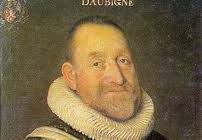
Agrippa d'Aubigné was a Huguenot, a soldier, a poet, and a historian — and immoderate in all of it. He fought through the Wars of Religion, wrote satires that gave offense to kings, and produced Les Tragiques, one of the darkest books of the French Renaissance.
He was born in 1552. His father, a Calvinist, died when Agrippa was eight, having first made the boy swear to avenge the Huguenots. He fought under Henry of Navarre, the future Henry IV; when Henry turned Catholic for the sake of the crown — "Paris is well worth a Mass" — d'Aubigné felt it as a betrayal.
Les Tragiques is seven books on the sufferings of the Huguenots, written in fury and in biblical imagery. It is not beautiful poetry; it is an indictment. His Histoire universelle, a history of the Wars of Religion, is another monumental labor.
After the assassination of Henry IV he emigrated to Geneva, where he wrote memoirs and satires. He died in 1630, at seventy-eight. His granddaughter, Françoise d'Aubigné, would become the Marquise de Maintenon, favorite of Louis XIV.