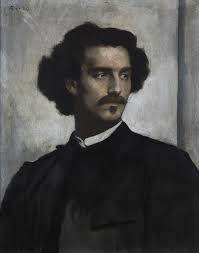
Educated at the lycée in Freiburg, he took up the serious study of drawing and painting in 1846 at the Düsseldorf Academy of Art. In 1848 he moved to Munich; then, wishing to perfect his color, he went to Antwerp and from there to Paris. From Paris, in 1853, Anselm von Feuerbach moved to Karlsruhe, and from 1855 he settled for many years in Rome. In 1873 the artist was invited to a professorship at the Vienna Academy of Fine Arts, but he resigned the post in 1878, convinced that teaching was not in him. He spent the last two years of his life in Venice.
He was the son of Professor Anselm Joseph von Feuerbach and a nephew of the philosopher Ludwig Feuerbach. After his schooling at the Freiburg lycée, he began serious study of drawing and painting in 1846 at the Düsseldorf Academy under Friedrich Wilhelm Schadow; but that painter's pietistic bent was not to his taste, and in 1848 he moved to Munich, where for nearly two years he studied to great profit under Karl Rahl. Then, to perfect his color, he traveled to Antwerp and thence to Paris, where he worked first under Couture's eye and afterwards on his own.
Besides Couture, Ingres exerted a great influence on him. The first picture he set before the public, in 1852 — "Hafiz at the Tavern" — was executed wholly in Couture's manner. In 1853 he moved from Paris to Karlsruhe to see his mother, and in the year or so he spent there painted "The Death of Pietro Aretino," a splendidly composed work, echoing partly Couture, partly the Venetian masters, but betraying the artist's fondness for cold, heavy, gray tones (it was finished in 1857). A stipend from the Grand Duke of Baden for travel in Italy took him to Venice, where, to improve his color, he made an excellent copy of Titian's "Assumption of the Virgin" and painted the lovely figure of "Poetry"; at last, from 1855, he settled in Rome for a long stay.
There he befriended the Munich art lover Baron Adolf Friedrich von Schack, who sustained him by buying his pictures and did much for his reputation. It was in Rome that Feuerbach produced his finest works: "Dante Walking with Noble Ladies in Ravenna" (1857, now in the Kunsthalle Karlsruhe), "Ariosto Among Noble Ladies at Ferrara" (1862), "Francesca da Rimini and Paolo Malatesta" (1863), "Laura and Petrarch," "The Mother of God and the Holy Women Mourning the Dead Savior" (1863), "A Tivoli Idyll," "Medea Before Her Departure into Exile" (1870, Neue Pinakothek, Munich), "The Judgment of Paris" (1871), "Iphigenia" (1871, in the Stuttgart Gallery), "The Battle of the Amazons" (1872), "Plato's Symposium" (1873, Neue Nationalgalerie, Berlin), and several others. In 1873 he was invited to a professorship at the Vienna Academy of Fine Arts, but gave it up in 1878, convinced of his unfitness for teaching.
His last two years were spent in Venice, at work on a ceiling painting commissioned for the assembly hall of the Vienna Academy. He managed to finish only its central picture, "The Fall of the Titans," and a few adjoining sections; the ceiling as a whole was completed from his sketches by Christian Griepenkerl and G. Tentschert in 1892. Joining classicism with romanticism, Feuerbach had a gift for inventing grand, painterly, deeply pondered compositions, for the rigorous working-out of form, for the plasticity of his modeling, and for giving his figures beautiful, natural movement and great expressiveness; yet his urge to charge a picture with a particular mood often robbed his color of freshness and brilliance, leaving his painting hazy, matte, and flat. He remains, for all that, an artist of the highest gifts, original and articulate in the expression of his ideas, and captivating in the nobility and beauty of the images he created.