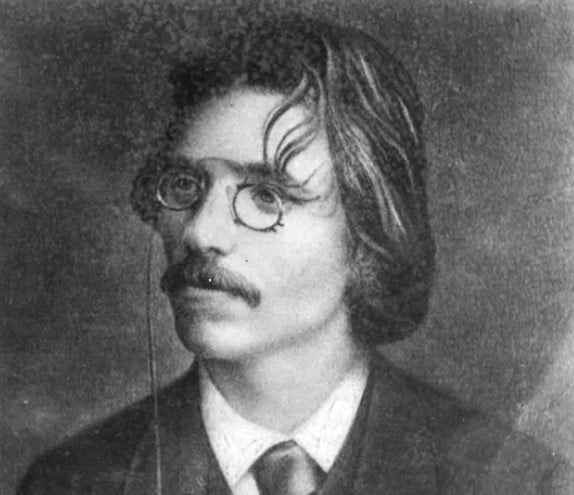
He was born in 1859 in a shtetl near Kiev. His mother died when he was thirteen. At fifteen he read Robinson Crusoe and wrote a version of his own — a Jewish Robinson — and decided to become a writer.
He worked as a private tutor and fell in love with his pupil, the daughter of a wealthy merchant. Her father threw him out. Six years later she married him anyway, against her father's will. On his father-in-law's death Sholem Aleichem came into a large inheritance, put it into the stock exchange, and lost everything.
From 1883 he wrote almost exclusively in Yiddish — not because he could not write in Russian or in Hebrew; he could. He wanted to be read by those who read only Yiddish: the ordinary Jewish families of the Pale of Settlement. Critics sneered at the jargon. He paid no attention.
His central characters are not heroes. Tevye the dairyman talks to God as to an old acquaintance who has some explaining to do. Menakhem-Mendl writes his wife letters about an endless string of deals that never come off. Motl is an orphan who is cheerful because he has not yet understood that he is supposed to grieve.
After the pogroms of 1905 he left Russia, living in Geneva, London, New York. In 1914, at the outbreak of war, he was expelled from Germany. He spent his last two years in New York — ill with tuberculosis, but still writing, still giving readings.
He died on 13 May 1916. A hundred thousand people came to his funeral in New York. His will asked that no grand speeches be made over him — only that his funny stories be read aloud once a year.
Fiddler on the Roof, drawn from his Tevye the Dairyman, became one of the longest-running shows in Broadway history.